
OrionBeacon


Leader election for .NET: run the same service on several instances and OrionBeacon keeps exactly one elected, so "only one node should do this" work runs once, not once per instance.
Part of the Orion family. Usable entirely on its own.
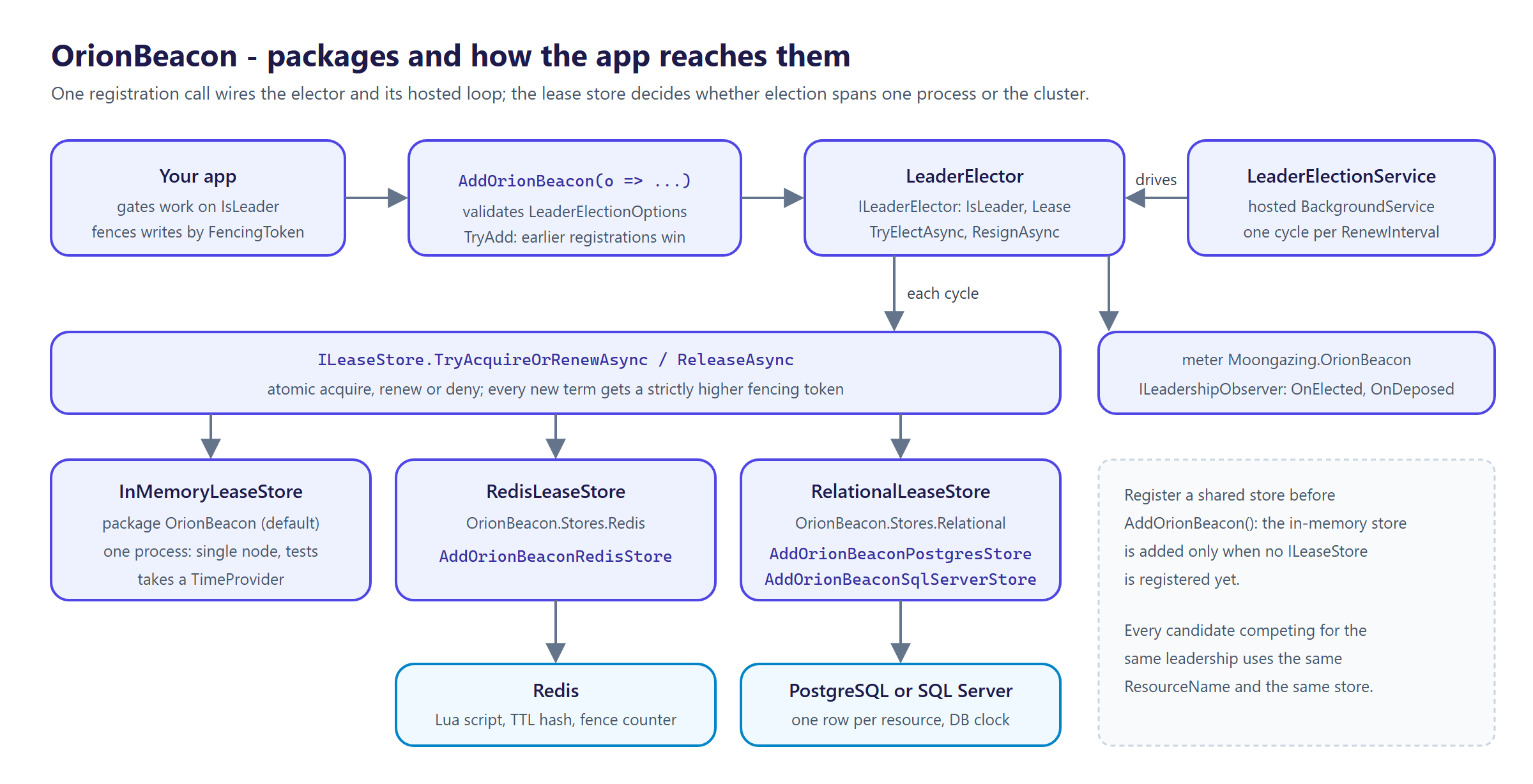
Packages
| Package | What it contains |
|---|---|
OrionBeacon | ILeaderElector, LeaderElectionService hosted loop, ILeaseStore with the in-process InMemoryLeaseStore, ILeadershipObserver, telemetry, AddOrionBeacon |
OrionBeacon.Stores.Redis | RedisLeaseStore (atomic Lua script, Redis Cluster safe), AddOrionBeaconRedisStore |
OrionBeacon.Stores.Relational | RelationalLeaseStore over PostgreSQL or SQL Server, AddOrionBeaconPostgresStore, AddOrionBeaconSqlServerStore |
Why
Scale a worker to three instances and your nightly job runs three times. The fix is leader election: candidates compete for a renewable lease in a shared store, the holder is the leader, and if it dies the lease lapses and another takes over. OrionBeacon implements that with fencing tokens (so a leader whose lease lapsed cannot keep writing as if it were still in charge) and a hosted loop that keeps the state current, leaving you a single IsLeader flag to check.
Features
- Renewable-lease election. Candidates compete for a lease over a named resource; the holder is the leader. Miss a renewal and the lease lapses, so a healthy follower takes over.
- Fencing tokens. Every new leadership term gets a strictly increasing
longtoken. Pass it to downstream resources to fence out a stale leader that resumed after a stop-the-world pause. - Hosted background loop.
AddOrionBeaconregisters aBackgroundServicethat acquires and renews on the renew interval, survives a transient store fault, and resigns on shutdown so a follower is promoted promptly. - A single
IsLeaderflag. Gate leader-only work onILeaderElector.IsLeader, or read the currentLeasefor its fencing token. - Pluggable storage. The default
InMemoryLeaseStoreelects within one process (single node or tests). To elect across a cluster, add the Redis or relational (PostgreSQL / SQL Server) store package, or implementILeaseStoreover any shared store; the in-memory store is only added if none is registered. - OpenTelemetry built in. A
MeternamedMoongazing.OrionBeaconexposes attempt and transition counters plus anis_leadergauge, built on the sharedOrion.Abstractionsinstrumentation spine so it follows the family's OTel naming and static-tag conventions. - Leadership-change events. Register an
ILeadershipObserverto react toOnElectedandOnDeposed. The observer is fault-safe: an exception it throws never disrupts election. - Testable by design. The election state machine advances one cycle at a time, so it is fully testable without real timers or sleeps.
InMemoryLeaseStorealso takes aTimeProvider, so a test can advance the clock past a lease's expiry and exercise time-driven failover with no real delay. - No heavy dependencies. The core package has two references:
Microsoft.Extensions.Hosting.AbstractionsandOrion.Abstractions(the family's shared contracts spine). Store drivers live in their own packages. Multi-targetsnet8.0,net9.0, andnet10.0.
Install
dotnet add package OrionBeacon
For election across a cluster, add one store package:
dotnet add package OrionBeacon.Stores.Redis
dotnet add package OrionBeacon.Stores.Relational
Quick start
Register OrionBeacon. The hosted loop starts acquiring and renewing the lease in the background.
builder.Services.AddOrionBeacon(o =>
{
    o.ResourceName = "nightly-report";
    o.LeaseDuration = TimeSpan.FromSeconds(15);
    o.RenewInterval = TimeSpan.FromSeconds(5);   // must be shorter than the lease
});
Gate leader-only work on the elector:
public sealed class NightlyReportJob(ILeaderElector elector)
{
    public async Task RunAsync(CancellationToken ct)
    {
        if (!elector.IsLeader)
        {
            return; // a different instance is the leader; do nothing here
        }

        long fence = elector.Lease!.FencingToken; // pass to downstream stores to reject stale writes
        await ProduceReportAsync(fence, ct);
    }
}
The hosted loop registered by AddOrionBeacon acquires and renews the lease in the background and resigns on shutdown, so a healthy follower is promoted promptly.
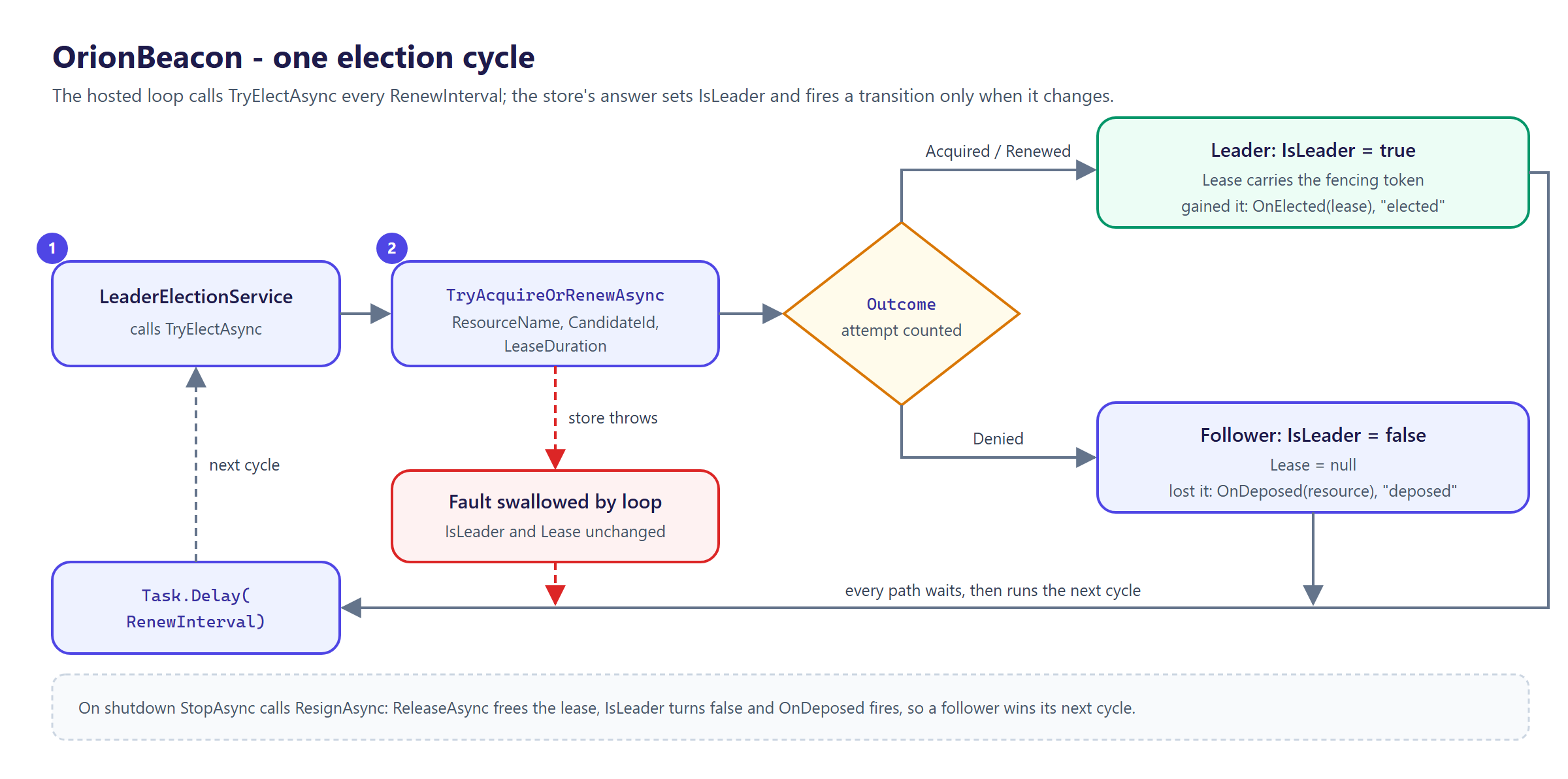
A store fault on one cycle is swallowed and retried on the next; IsLeader and Lease keep their previous values until a cycle succeeds.
Usage
Check leadership
ILeaderElector is the surface application code touches. IsLeader is true while this candidate holds the lease, and Lease is the current lease (or null for a follower).
public sealed class OutboxDrain(ILeaderElector elector)
{
    public bool ShouldRun => elector.IsLeader;

    public long? CurrentFence => elector.Lease?.FencingToken;
}
Fence downstream writes
Each leadership term carries a strictly increasing fencing token. Pass it to any resource the leader writes to and have that resource reject anything carrying a lower token than the highest it has seen. This is what makes election safe under a stop-the-world pause: a leader that was frozen past its lease, then resumed, carries a stale token and is fenced out.
if (elector is { IsLeader: true, Lease: { } lease })
{
    await store.WriteAsync(payload, fencingToken: lease.FencingToken, ct);
}
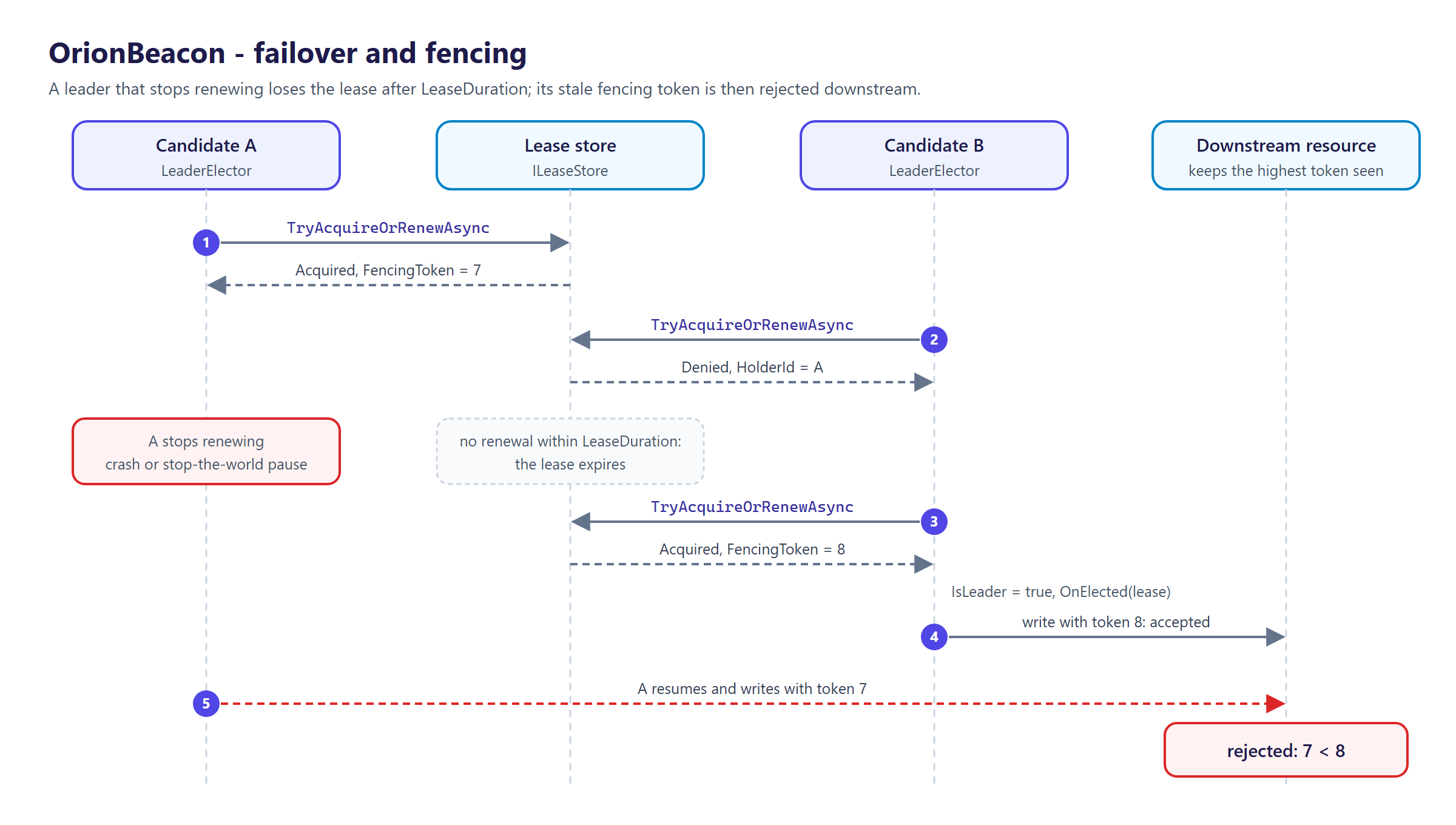
Elect across a cluster with Redis or a database
The default InMemoryLeaseStore elects a leader only within one process. Register a shared store before AddOrionBeacon(); the in-memory store is only added if no ILeaseStore is present.
// Redis (OrionBeacon.Stores.Redis)
builder.Services.AddOrionBeaconRedisStore("localhost:6379");

// or PostgreSQL / SQL Server (OrionBeacon.Stores.Relational)
builder.Services.AddOrionBeaconPostgresStore("Host=localhost;Database=app;Username=app;Password=secret");
builder.Services.AddOrionBeaconSqlServerStore("Server=localhost;Database=app;User Id=sa;Password=secret;TrustServerCertificate=True");

builder.Services.AddOrionBeacon(o => o.ResourceName = "jobs");
Register one of them. RedisLeaseStoreOptions sets KeyPrefix (default orionbeacon:lease:) and Database (default -1, the connection's default); RelationalLeaseStoreOptions sets TableName (default orionbeacon_leases, created on first use) and CommandTimeout (default 30 seconds). Every candidate must point at the same store. See each package's README under src/*/docs/ for details.
A custom ILeaseStore
For any other shared store, implement ILeaseStore yourself and register it the same way.
public sealed class EtcdLeaseStore : ILeaseStore
{
    public Task<LeaseAcquisition> TryAcquireOrRenewAsync(
        string resource, string candidateId, TimeSpan duration, CancellationToken cancellationToken = default)
    {
        // Atomically: acquire if free or expired, renew if this candidate holds it,
        // otherwise deny. Hand out a strictly increasing fencing token on each new term.
        // ...
    }

    public Task ReleaseAsync(string resource, string candidateId, CancellationToken cancellationToken = default)
    {
        // Release only if this candidate holds the lease, so a follower can take over at once.
        // ...
    }
}
builder.Services.AddSingleton<ILeaseStore, EtcdLeaseStore>();
builder.Services.AddOrionBeacon(o => o.ResourceName = "jobs");
Two rules an implementation must honour: TryAcquireOrRenewAsync must be atomic so two candidates cannot both acquire, and it must assign a strictly increasing fencing token on each new acquisition. LeaseAcquisition reports the Outcome (Acquired, Renewed, or Denied), the Lease held on acquire or renew, and the HolderId on denial.
React to leadership changes
Register an ILeadershipObserver to run code when this candidate gains or loses leadership. Implementations are observability only and must not throw; the elector swallows any fault so an observer outage never disrupts election.
public sealed class LoggingObserver(ILogger<LoggingObserver> logger) : ILeadershipObserver
{
    public void OnElected(Lease lease) =>
        logger.LogInformation("Elected leader of {Resource}, fence {Token}", lease.Resource, lease.FencingToken);

    public void OnDeposed(string resource) =>
        logger.LogInformation("Lost leadership of {Resource}", resource);
}
builder.Services.AddSingleton<ILeadershipObserver, LoggingObserver>();
builder.Services.AddOrionBeacon();
Configuration
AddOrionBeacon takes an optional Action<LeaderElectionOptions>. Options are validated on registration, so an invalid combination throws at startup rather than failing silently later.
| Option | Default | Meaning |
|---|---|---|
ResourceName | orion-leader | The contended resource. Every candidate competing for the same leadership must use the same value. |
CandidateId | machine name + per-process suffix | This instance's stable, unique identity. |
LeaseDuration | 15 seconds | How long a lease is granted. If the leader fails to renew within this window, the lease lapses and a follower can take over. |
RenewInterval | 5 seconds | How often the leader renews and a follower retries. Must be shorter than LeaseDuration so renewals beat expiry. |
RenewInterval must be positive and strictly shorter than LeaseDuration; LeaseDuration must be positive; ResourceName and CandidateId must be non-empty. A shorter renew interval relative to the lease tolerates more missed renewals before failover; a longer lease tolerates longer store outages at the cost of slower failover.
Telemetry and events
OrionBeacon exposes a System.Diagnostics.Metrics.Meter named Moongazing.OrionBeacon (the constant LeaderElectionDiagnostics.MeterName). Subscribe to it from OpenTelemetry:
orion.beacon.attempts(counter, taggedorion.outcome=acquired/renewed/denied) - lease acquisition attempts.orion.beacon.transitions(counter, taggeddirection=elected/deposed) - leadership transitions.orion.beacon.is_leader(observable gauge) -1while this candidate holds leadership, otherwise0.
builder.Services.AddOpenTelemetry()
    .WithMetrics(m => m.AddMeter(LeaderElectionDiagnostics.MeterName));
For event-driven reactions rather than metrics, register an ILeadershipObserver (see Usage above).
Testing
The election state machine is driven one cycle at a time through ILeaderElector.TryElectAsync, so it is fully testable without real timers or sleeps; the hosted service simply calls it on the renew interval. Tests drive cycles directly and inject a controllable clock into InMemoryLeaseStore to advance time deterministically.
var store = new InMemoryLeaseStore();
var options = new LeaderElectionOptions { ResourceName = "res", CandidateId = "a" };
var elector = new LeaderElector(store, options, new LeaderElectionDiagnostics());

bool isLeader = await elector.TryElectAsync(); // first cycle wins; fencing token starts at 1
To test time-driven failover, build the store on a controllable TimeProvider and advance it past the lease duration; the follower then wins the next cycle once the lease has lapsed.
var clock = new FakeTimeProvider();                // Microsoft.Extensions.Time.Testing
var store = new InMemoryLeaseStore(clock);

await holder.TryElectAsync();                       // holder takes the lease
clock.Advance(options.LeaseDuration + TimeSpan.FromSeconds(1)); // lease lapses
bool followerWins = await follower.TryElectAsync(); // follower wins the next cycle
Run the library's own suite from the repository root:
dotnet test
tests/Moongazing.OrionBeacon.Conformance.Tests runs the shared ILeaseStore contract against the in-memory store and against real Redis, PostgreSQL and SQL Server containers through Testcontainers, so Docker must be running for those.
Benchmarks
A BenchmarkDotNet suite covers the in-memory election hot paths: the lease-store critical section, a full elector cycle, and the small value objects on the path. No measured numbers are committed because results are hardware- and runtime-specific. See benchmarks.md for how to run them.
dotnet run -c Release --project benchmarks/Moongazing.OrionBeacon.Benchmarks
Versioning
OrionBeacon follows SemVer. The packages multi-target net8.0, net9.0, and net10.0. The project builds with TreatWarningsAsErrors, nullable reference types enabled, and the latest-recommended analyzers. Notable changes are recorded in CHANGELOG.md.
The current release, 0.5.0, moves the telemetry onto the shared Orion.Abstractions 1.0 instrumentation spine. The meter name is unchanged, but the instruments were renamed (orionbeacon.* to orion.beacon.*, and the attempts tag outcome to orion.outcome), so update dashboards and alerts; see the changelog for the full table.
More from the Orion family
OrionBeacon is one of a set of standalone .NET libraries:
- OrionGuard - validation, guard clauses, and DDD primitives.
- OrionAudit - automatic EF Core change-audit trail.
- OrionKey - source-generated strongly-typed IDs.
- OrionLock - distributed locking.
- OrionPatch - transactional outbox for EF Core.
Documentation
- docs/FEATURES.md - a deeper breakdown of every capability and the type behind it.
- docs/ROADMAP.md - ideas under consideration, no promised dates.
- benchmarks.md - the benchmark suite and how to run it.
- Package READMEs (the nuget.org pages): OrionBeacon, OrionBeacon.Stores.Redis, OrionBeacon.Stores.Relational.
Contributing
Issues and pull requests welcome. Please read CONTRIBUTING.md and the Code of Conduct before opening one. Report vulnerabilities privately as described in SECURITY.md.
License
This project is licensed under the MIT License.
Author
Tunahan Ali Ozturk - GitHub
Packages
| Package | Version | Downloads |
|---|---|---|
| OrionBeacon | 0.5.0 | 905 |
| OrionBeacon.Stores.Redis | 0.5.0 | 307 |
| OrionBeacon.Stores.Relational | 0.5.0 | 299 |