
OrionClock


A TimeProvider-based clock for the Orion family. Time is the most-faked and worst-faked dependency in a .NET backend: teams reach for DateTime.UtcNow, sprinkle it through domain code, then discover none of it is testable. .NET 8 shipped TimeProvider — the right primitive — but it deliberately left out a schedule/TTL vocabulary, so every package re-derives its own expiry math and flaky "wait for it to expire" tests.
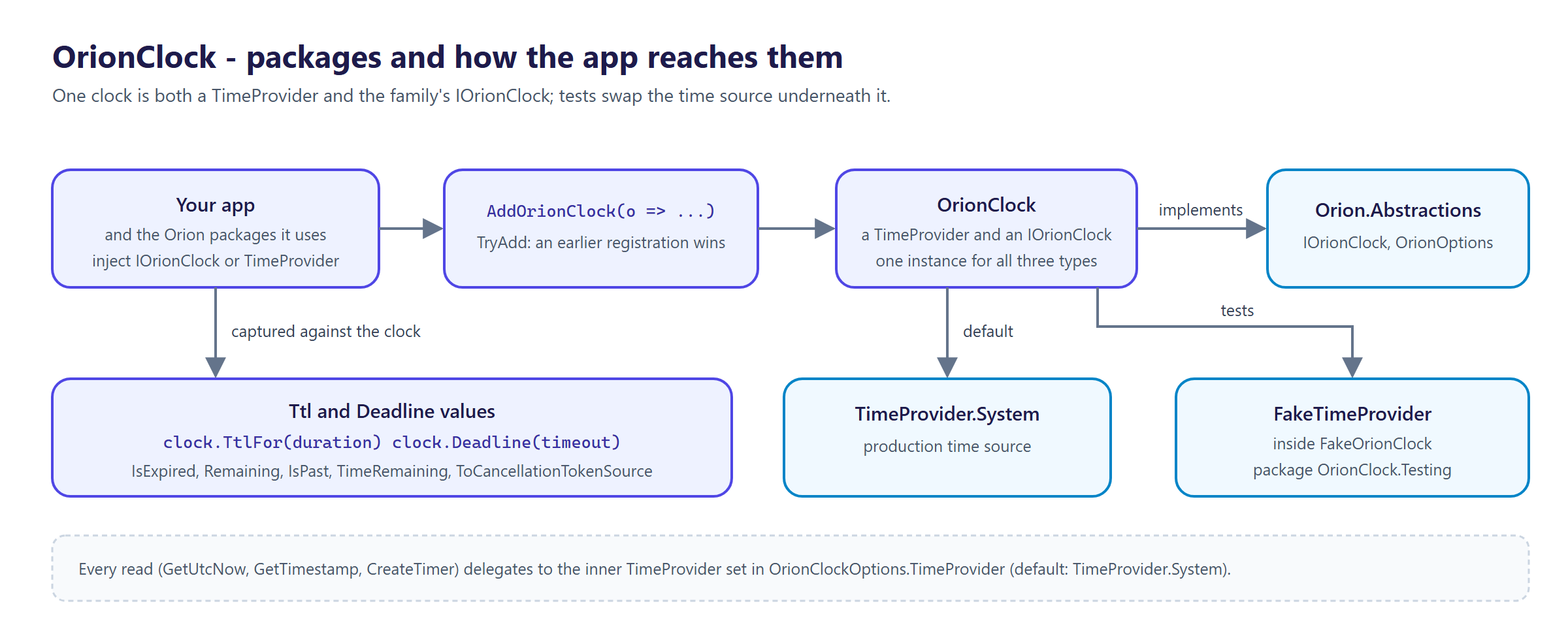
OrionClock is the thin, opinionated layer on top. It is a TimeProvider (so it drops into any BCL API that takes one), it is the family's IOrionClock, and it adds the Ttl/Deadline vocabulary the whole suite shares — deterministic under a fake clock that advances the entire suite at once.
Packages
| Package | What it contains |
|---|---|
OrionClock | OrionClock (TimeProvider + IOrionClock), Ttl, Deadline, AddOrionClock |
OrionClock.Testing | FakeOrionClock, a controllable clock for tests built on FakeTimeProvider |
Features
- It is a
TimeProvider— anything that accepts aTimeProvider(CancellationTokenSource,Task.Delay, timers) accepts anOrionClock. Subclasses the BCL primitive rather than replacing it. - It is the family's
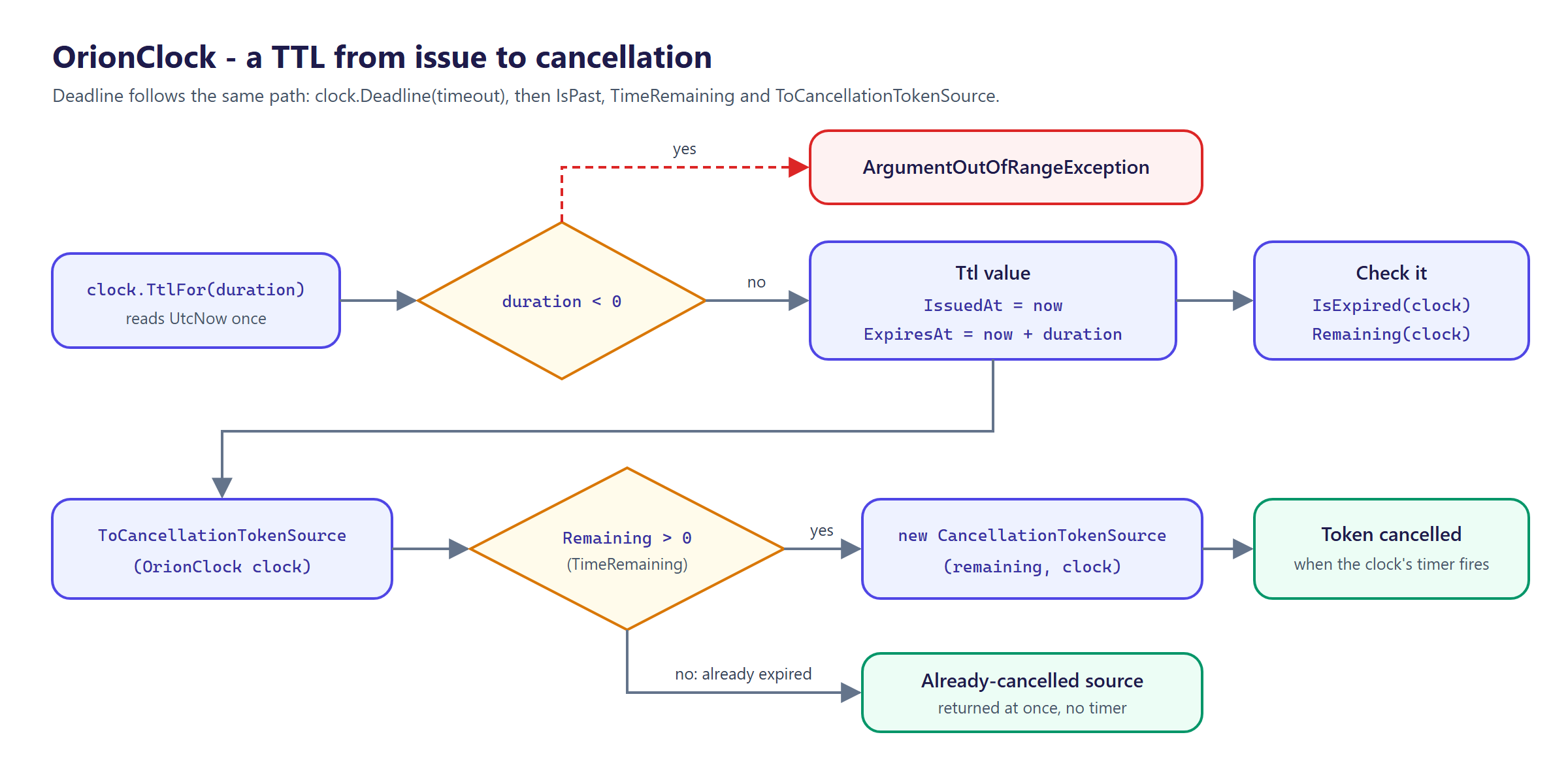
IOrionClock— one clock, registered asTimeProviderandIOrionClock, so every Orion package reads the same time source (unless you registered your ownTimeProviderorIOrionClockfirst; see One-line DI below). Ttl— a time-to-live as a first-class value (issue instant + expiry captured together).IsExpired,Remaining(clamped non-negative),ToCancellationTokenSourcefor TTL-driven cancellation.Deadline— a "must complete by" instant withIsPast,TimeRemaining, and deadline-driven cancellation.- Deterministic in tests —
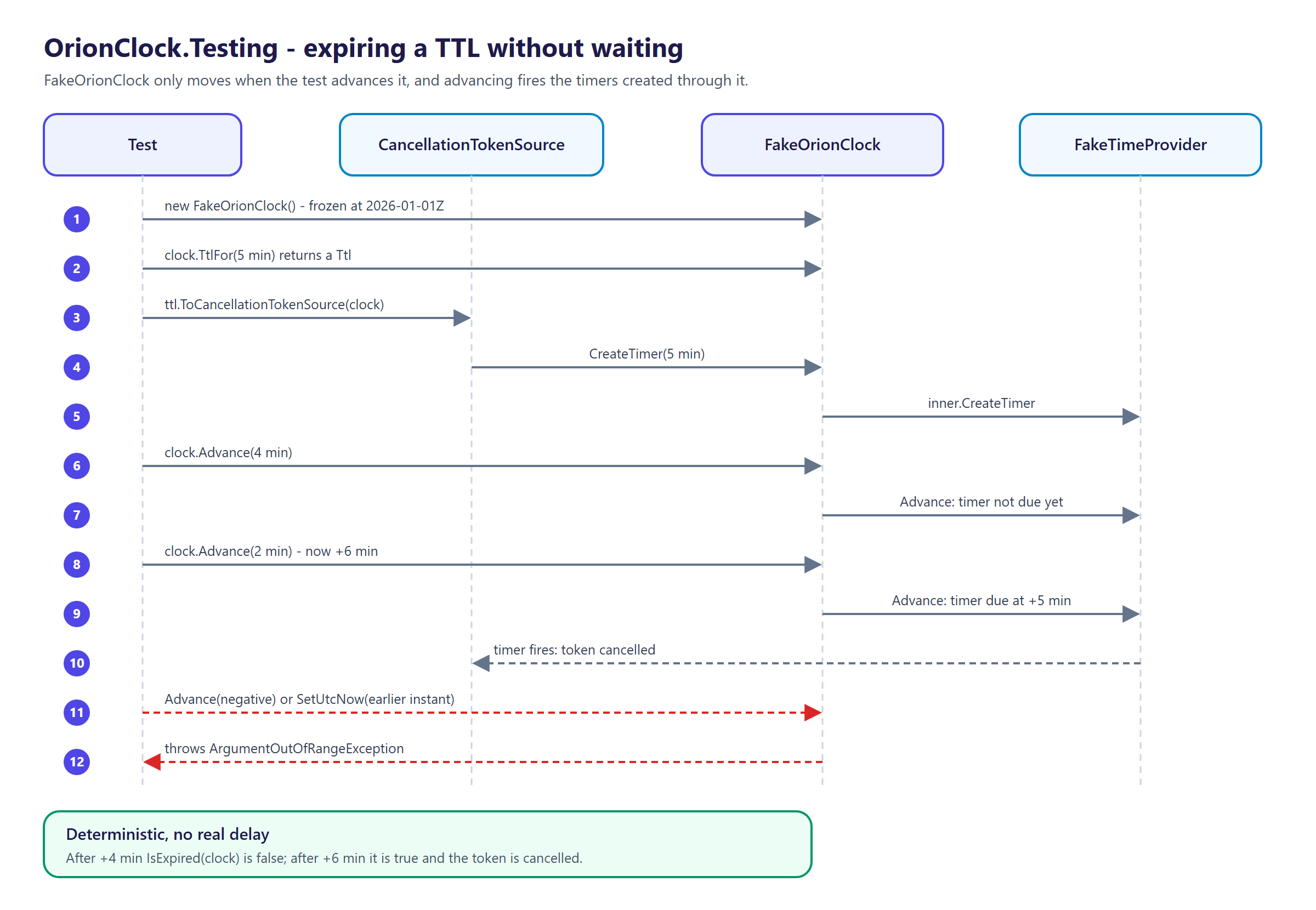
FakeOrionClock(inOrionClock.Testing) freezes time and only moves onAdvance/SetUtcNow. Because it is built onTimeProvider, advancing it fires the timers and cancellation sources created through it — so a 5-minute TTL is expired afterAdvance(6m)and not afterAdvance(4m), with no real delay. - One-line DI (
AddOrionClock) — registers viaTryAdd, so a consumer override wins and calling it twice is a no-op. Each service type is a separateTryAdd: if you registered only one ofOrionClock,TimeProviderorIOrionClockyourself, that one keeps your registration and the other two still resolve to theOrionClock, so they no longer share one instance. To swap the time source for all three, setOrionClockOptions.TimeProvider(see Testing). - AOT- and trim-clean, verified by a native-binary smoke test in CI. Multi-targets
net8.0,net9.0,net10.0.
Install
dotnet add package OrionClock

# Testing companion (FakeOrionClock), reference from test projects only
dotnet add package OrionClock.Testing
OrionClock depends only on Microsoft.Extensions.DependencyInjection.Abstractions. The quick start below builds its own container with BuildServiceProvider(), so a console app or test project also needs dotnet add package Microsoft.Extensions.DependencyInjection. ASP.NET Core and Generic Host apps already reference it.
Quick start
using Microsoft.Extensions.DependencyInjection;
using Moongazing.Orion.Abstractions.Time;
using Moongazing.OrionClock;

var services = new ServiceCollection();
services.AddOrionClock(); // registers OrionClock as TimeProvider AND IOrionClock

using var provider = services.BuildServiceProvider();
var clock = provider.GetRequiredService<IOrionClock>();

// A TTL as a value, not a raw DateTimeOffset you must remember to compare in UTC.
Ttl ttl = clock.TtlFor(TimeSpan.FromMinutes(5));
if (ttl.IsExpired(clock)) { /* ... */ }
TimeSpan left = ttl.Remaining(clock); // never negative

// A deadline that drives cancellation.
Deadline deadline = clock.Deadline(TimeSpan.FromSeconds(30));
using var cts = deadline.ToCancellationTokenSource((OrionClock)clock);
await DoWorkAsync(cts.Token);
Testing
Point the clock at FakeOrionClock and advance time by hand — no real delays, no flakiness.
using Moongazing.OrionClock;
using Moongazing.OrionClock.Testing;

var clock = new FakeOrionClock(); // frozen at 2026-01-01Z by default
var ttl = clock.TtlFor(TimeSpan.FromMinutes(5));

clock.Advance(TimeSpan.FromMinutes(4));
Assert.False(ttl.IsExpired(clock));

clock.Advance(TimeSpan.FromMinutes(2)); // now +6m
Assert.True(ttl.IsExpired(clock));
Register the fake through options so the whole graph uses it:
var fake = new FakeOrionClock();
services.AddOrionClock(o => o.TimeProvider = fake);
Because FakeOrionClock is a TimeProvider, a CancellationTokenSource built from a Ttl or Deadline cancels exactly when you advance past it — deterministically.
Versioning
Follows Semantic Versioning. Multi-targets net8.0, net9.0, and net10.0. Binds to Orion.Abstractions 1.x.
Documentation
- CHANGELOG.md — release notes.
- SECURITY.md — how to report a vulnerability.
Contributing
Contributions are welcome. See CONTRIBUTING.md and the CODE_OF_CONDUCT.md.
More from the Orion family
Focused .NET libraries built to one quality bar. Each is usable on its own; several share the small Orion.Abstractions contracts spine, but there is no deep dependency web — pick only what you need:
- OrionGuard — validation, guard clauses, DDD primitives, domain events
- Orion.Abstractions — the shared contracts spine: telemetry, options, result, clock
- OrionAudit — automatic EF Core change-audit trail
- OrionBeacon — leader election with fencing tokens
- OrionGrant — permission / authorization checks
- OrionKey — source-generated strongly-typed IDs
- OrionLedger — API-key issuance, verification, and rotation
- OrionLens — ambient correlation-context propagation
- OrionLock — distributed locks with fencing tokens
- OrionOnce — idempotency keys for exactly-once request handling
- OrionPatch — transactional outbox for EF Core
- OrionRelay — outbound webhook delivery (HMAC, retries, backoff)
- OrionResult — Result/Option types and a shared error vocabulary
- OrionSaga — sagas / process managers for long-running workflows
- OrionShade — sensitive-data redaction for logs and telemetry
- OrionStream — server-sent events / streaming hub
- OrionVault — field-level encryption for EF Core
See it all working together in OrionShowcase, a production-shaped banking sample.
License
MIT.
Packages
| Package | Version | Downloads |
|---|---|---|
| OrionClock | 0.9.0 | 611 |
| OrionClock.Testing | 0.9.0 | 414 |