OrionKey

OrionKey
Source-generated strongly-typed IDs for .NET.



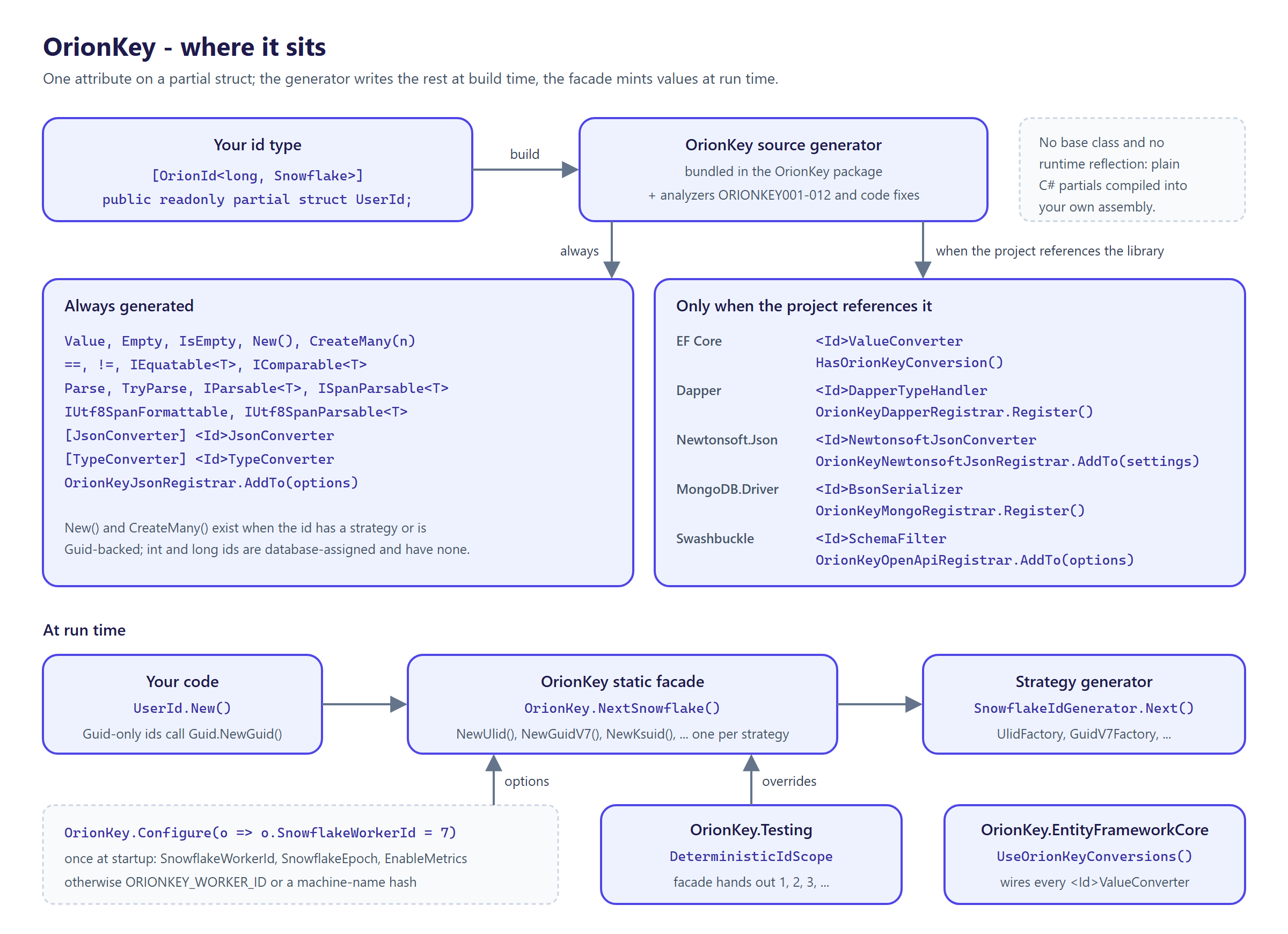
OrionKey turns a readonly partial struct into a fully-featured strongly-typed ID with a
single attribute. A bundled Roslyn source generator emits the equality, comparison, factory,
serialization, and persistence members, so a domain ID stops being a bare Guid or long
and becomes a distinct type the compiler can check. There is no base class and no runtime
reflection: declare the struct, build, use it.
How it works
Packages
| Package | What it is |
|---|---|
OrionKey | The [OrionId] attributes, strategy markers and OrionKey facade, with the source generator, analyzers and code fixes bundled in the same package. |
OrionKey.EntityFrameworkCore | Model-wide EF Core converter registration: UseOrionKeyConversions(), ConfigureOrionKeyConversions() and a generic HasOrionKeyConversion<TId, TValue>(). |
OrionKey.Testing | DeterministicIdScope and sequential generators for repeatable ids in tests. |
Snowflake ids
A 64-bit Snowflake id packs three fields into a long: a millisecond timestamp relative to a
fixed epoch, a per-process worker id, and a per-millisecond sequence counter. The layout is
what makes Snowflake ids time-sortable, unique across instances without coordination, and free
of allocation.
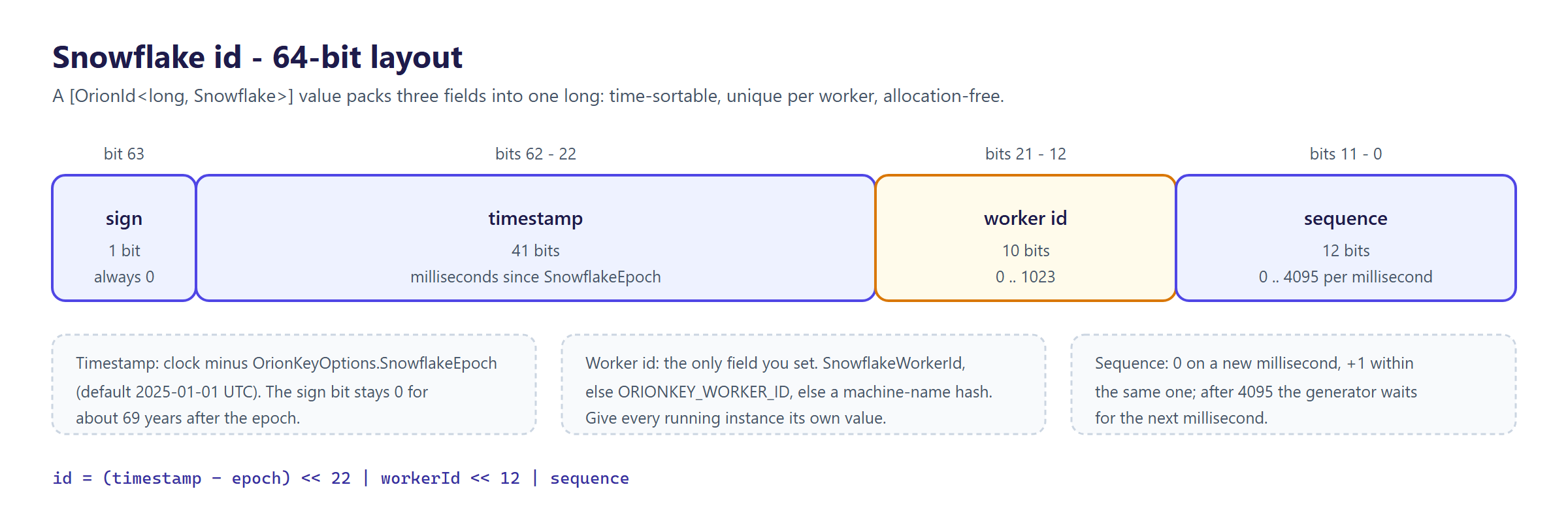
Worker id is the only field that needs human attention; the timestamp comes from the clock and
the sequence is internal. Pin it with OrionKey.Configure(o => o.SnowflakeWorkerId = N) or
the ORIONKEY_WORKER_ID environment variable in every replica.
Quick start
dotnet add package OrionKey
Declare an ID by marking a partial struct with [OrionId] and a storage type. The optional
second type argument selects a generation strategy:
using Moongazing.OrionKey;

[OrionId<Guid>]              public readonly partial struct OrderId;
[OrionId<long, Snowflake>]   public readonly partial struct UserId;
[OrionId<string, Ulid>]      public readonly partial struct TenantId;
[OrionId<string, NanoId>]    public readonly partial struct SessionId;
Each struct now has a New() factory, value equality, parsing, and serialization:
var id = OrderId.New();

OrderId a = OrderId.New();
OrderId b = a;
Console.WriteLine(a == b);   // true, value equality

// Works as-is with System.Text.Json
var json = JsonSerializer.Serialize(new { OrderId = id });

// Works as-is as a minimal-API route parameter
app.MapGet("/orders/{id}", (OrderId id) => /* ... */);
The generated System.Text.Json converter and TypeConverter are attached to the struct by
attributes, and the public TryParse overloads are what ASP.NET Core route binding looks for, so
reflection-based System.Text.Json and model binding need no registration.
EF Core is the exception: the generator emits an <Id>ValueConverter and a
HasOrionKeyConversion() property helper when the project references EF Core, but EF Core does
not pick a converter up on its own. Wire it per property, or for the whole model with the
OrionKey.EntityFrameworkCore package:
protected override void OnModelCreating(ModelBuilder modelBuilder)
{
    // Per property, with the helper generated next to OrderId:
    modelBuilder.Entity<Order>().Property(o => o.Id).HasOrionKeyConversion();

    // Or every [OrionId] property at once (OrionKey.EntityFrameworkCore):
    // modelBuilder.UseOrionKeyConversions();
}
Analyzer ORIONKEY006 warns when an id property of an entity has no converter configured.
Strategies
| Declaration | Storage | New() | Sortable |
|---|---|---|---|
[OrionId<Guid>] | Guid | Guid.NewGuid() | no |
[OrionId<Guid, GuidV7>] | Guid | UUIDv7 | yes |
[OrionId<Guid, SequentialGuid>] | Guid | SQL Server-ordered sequential GUID | yes |
[OrionId<long, Snowflake>] | long | Snowflake | yes |
[OrionId<string, Ulid>] | string | ULID | yes |
[OrionId<string, Ksuid>] | string | KSUID | yes |
[OrionId<string, ObjectId>] | string | MongoDB ObjectId (24-char hex) | yes |
[OrionId<string, MonotonicHex>] | string | 32-char lowercase hex, time-ordered | yes |
[OrionId<string, NanoId>] | string | NanoId | no |
[OrionId<string, Cuid2>] | string | CUID2 | no |
[OrionId<int>] / [OrionId<long>] | int/long | none (DB identity) | n/a |
The int and long integer forms have no New() factory; they model ids assigned
externally, typically by a database identity column.
MonotonicHex
MonotonicHex produces a 32-character lowercase hex string built from a 48-bit millisecond
Unix timestamp (big-endian) followed by 80 bits of randomness. The big-endian layout and the
0-9a-f alphabet make ordinal string comparison equal chronological order, so the raw string
sorts the same way in code, in a database index, and in a hex-sorted store. Ids minted within
the same millisecond are strictly increasing within a process: the randomness block is
incremented rather than re-drawn, so a sequence is monotonic. If the clock steps backwards
(NTP correction, leap second) the previous timestamp is held so the sequence never regresses.
[OrionId<string, MonotonicHex>] public readonly partial struct TraceId;

var a = TraceId.New();
var b = TraceId.New();

// Ordinal order equals creation order; b was minted after a.
Console.WriteLine(string.CompareOrdinal(a.Value, b.Value) < 0);   // true
The runtime factory is also exposed directly for code that needs a raw id without a wrapper
struct: OrionKey.NewMonotonicHex() returns the same 32-char lowercase hex string.
What gets generated
For every annotated struct the generator emits, as partial companions:
- The struct body itself: a
Valuemember,EmptyandIsEmpty, aNew()factory andCreateMany(count)(strategy-backed andGuidtypes),WrapAll/UnwrapAll, and value-basedIEquatableequality with==/!=. - An
IComparable/IComparable<T>implementation with<,<=,>,>=, for every id. Sortable strategies (GuidV7,SequentialGuid,Snowflake,Ulid,Ksuid,ObjectId,MonotonicHex) compare in creation order; the others compare by value, which is stable but not chronological. - A
System.Text.JsonJsonConverterso the id serializes as its underlying value. - A
TypeConverterfor framework conversions and ASP.NET Core model binding. IParsable<T>andISpanParsable<T>implementations plus publicParseandTryParsemethods (andParseOrDefaultforGuid,intandlongids), andIUtf8SpanFormattable/IUtf8SpanParsable<T>for UTF-8 I/O.- An EF Core
<Id>ValueConverterand aHasOrionKeyConversion()property helper, emitted only when the project references EF Core (see Quick start for wiring them).
Library integration
OrionKey emits additional companions automatically when the consumer project references any of these libraries. There is no extra configuration — the source generator probes the compilation and only emits what the project can use.
| Library | Generated companion | One-line registration |
|---|---|---|
| System.Text.Json (source-gen) | OrionKeyJsonConverterFactory | OrionKeyJsonRegistrar.AddTo(options); |
| Dapper | <Id>DapperTypeHandler | OrionKeyDapperRegistrar.Register(); |
| Newtonsoft.Json | <Id>NewtonsoftJsonConverter | OrionKeyNewtonsoftJsonRegistrar.AddTo(settings); |
| MongoDB driver | <Id>BsonSerializer | OrionKeyMongoRegistrar.Register(); |
| Swashbuckle (OpenAPI) | <Id>SchemaFilter | OrionKeyOpenApiRegistrar.AddTo(options); |
Each registrar enumerates every [OrionId] struct in the assembly and wires it into the library's registry, so a single call covers every id you have declared.
For ordinary reflection-based System.Text.Json and ASP.NET Core model binding, the generated companions are found through their attributes and public TryParse, so no registrar call is required. EF Core converters are wired with HasOrionKeyConversion() or OrionKey.EntityFrameworkCore, as shown in Quick start. The OrionKeyJsonRegistrar.AddTo(options) call exists for the reflection-free source-generation path: pair it with a JsonSerializerContext constructed over those options, as covered in AOT & trimming below.
System.Text.Json source-generation
OrionKeyJsonRegistrar.AddTo(JsonSerializerOptions) registers every generated id converter on the supplied options in one call, backed by OrionKeyJsonConverterFactory, a reflection-free JsonConverterFactory that resolves the assembly's [OrionId] types through a compile-time type switch. This is the path to use with a source-generated JsonSerializerContext, where the per-id [JsonConverter] attribute is not visible to the System.Text.Json generator. Register the converters first, then construct the context over those same options:
var options = new JsonSerializerOptions();
OrionKeyJsonRegistrar.AddTo(options);     // wires every [OrionId] converter, AOT-safe
var ctx = new MyJsonContext(options);     // construct the context over those options

var json = JsonSerializer.Serialize(OrderId.New(), ctx.OrderId);
var id = JsonSerializer.Deserialize(json, ctx.OrderId);
Constructing the context with a bare MyJsonContext.Default does not honor the converters, because Default is built over an internal options instance that never saw the AddTo call. Always build the context over the options you registered into. Ids still serialize as their bare scalar (string or number) shape.
AOT & trimming
OrionKey is compatible with Native AOT (<PublishAot>true</PublishAot>) and trimming (<PublishTrimmed>true</PublishTrimmed>). All three packages (OrionKey, OrionKey.Testing, OrionKey.EntityFrameworkCore) carry <IsAotCompatible>true</IsAotCompatible>, every generated converter is reachable via attributes (no runtime reflection scan), and CI publishes and runs a self-contained AOT sample binary on linux-x64 and win-x64 on every push and pull request to prove the toolchain stays clean. In OrionKey.EntityFrameworkCore, the model-wide UseOrionKeyConversions() and ConfigureOrionKeyConversions() discover ids by reflection and are annotated RequiresUnreferencedCode / RequiresDynamicCode; under AOT use the per-property HasOrionKeyConversion() instead.
Three Phase B integration libraries — Newtonsoft.Json, MongoDB.Driver, and Swashbuckle.AspNetCore — are not AOT-clean as of mid-2026. Their OrionKey emitters continue to work in non-AOT projects; if your project publishes AOT, prefer System.Text.Json, EF Core, and the BCL TypeConverter / IParsable pipelines. See sample/Moongazing.OrionKey.AotSample for a working end-to-end example.
Two AOT-specific patterns the sample demonstrates:
System.Text.Jsonwith a source-generated context. Source generators don't see each other's emitted attributes, so the[JsonConverter]attribute OrionKey emits is invisible to theSystem.Text.Jsonsource generator. Register the generated converters withOrionKeyJsonRegistrar.AddTo(options)at startup, then construct yourJsonSerializerContextwith those options (new MyContext(options)) and serialize via the context's per-type properties.IParsable<T>in generic code. TheIParsable<T>/ISpanParsable<T>members are explicit interface implementations that forward to the publicParse/TryParsemethods. Generic code calls them through a constraint,where T : IParsable<T>, withT.Parse(text, null); non-generic code can callMyId.Parse(text)directly.
Dapper note: The OrionKey-generated <Id>DapperTypeHandler is AOT-compatible, but the Dapper assembly itself (2.1.35) produces aggregate IL2104/IL3053 warnings during AOT publish because the Dapper team has not yet annotated it as trim-safe. AOT consumers can either suppress these per-assembly warnings (at their own risk) or wait for an upstream Dapper release that ships trim/AOT annotations. The AOT sample in this repo deliberately omits Dapper for that reason.
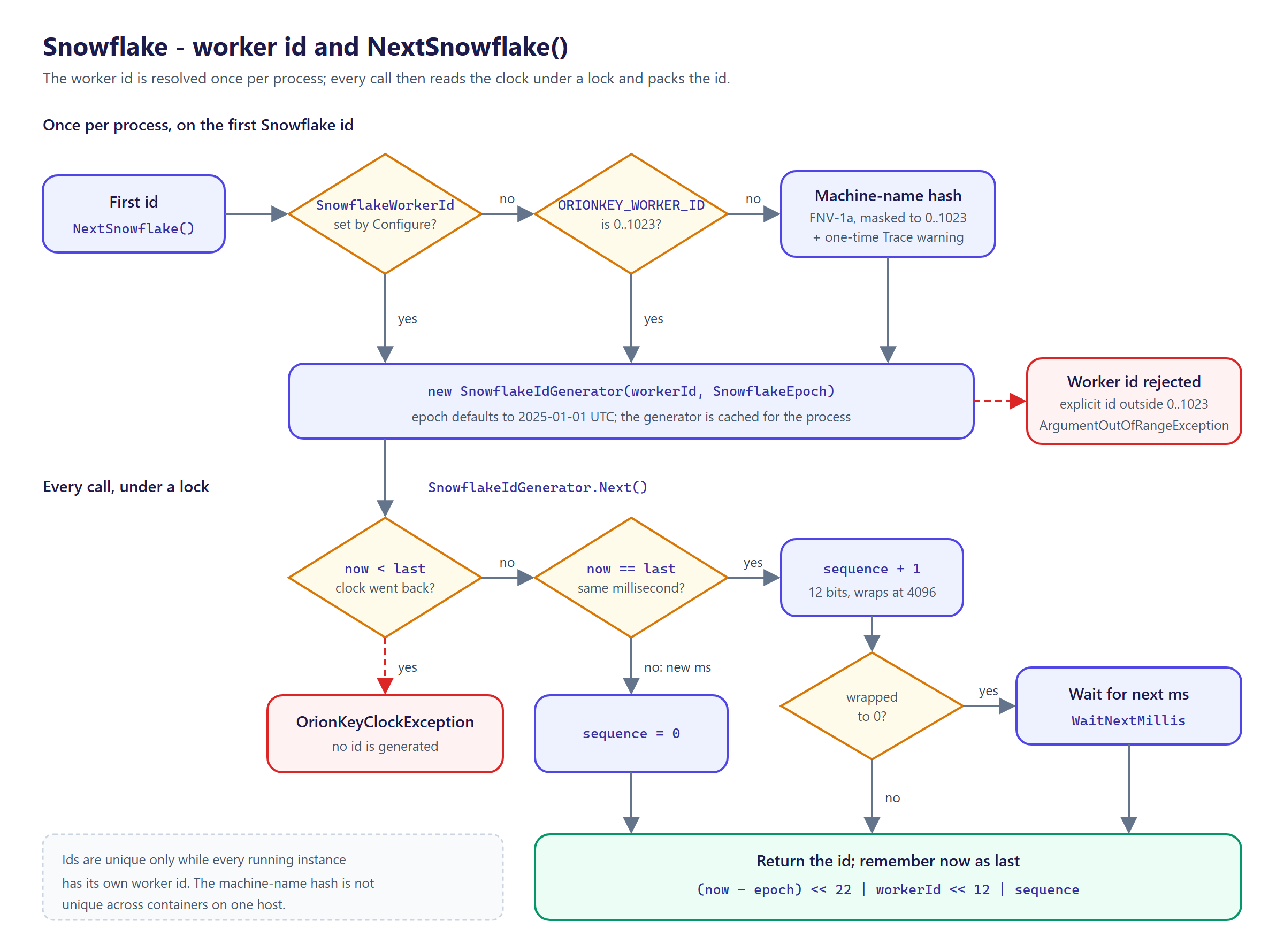
Snowflake worker IDs
Snowflake ids embed a per-process worker ID (10 bits, 0-1023) to stay unique across
instances. Configure it explicitly with
OrionKey.Configure(o => o.SnowflakeWorkerId = N) or the ORIONKEY_WORKER_ID environment
variable; otherwise OrionKey derives one from the machine name and writes a one-time
warning. In any multi-instance deployment you should pin the worker ID explicitly. See
docs/snowflake-worker-ids.md for details.
Benchmarks
A BenchmarkDotNet suite covers raw generation per strategy
(against a Guid.NewGuid() baseline), the overhead of the generated wrapper, parsing, and
formatting / equality. benchmarks.md explains what each class measures; it
deliberately quotes no fixed figures, because they depend on your CPU and runtime. Run it
locally:
dotnet run -c Release --project benchmarks/Moongazing.OrionKey.Benchmarks
Testing
The OrionKey.Testing package makes generated ids predictable in tests. While a
DeterministicIdScope is alive, the OrionKey facade hands out ascending, repeatable values
(1, 2, 3, ... in each strategy's shape) instead of random or time-based ones; disposing it
restores the normal generators.
using Moongazing.OrionKey.Testing;

using (new DeterministicIdScope())
{
    var first = UserId.New();    // Snowflake: 1
    var second = UserId.New();   // Snowflake: 2
}
The scope covers every strategy-backed id. A plain [OrionId<Guid>] id calls
Guid.NewGuid() directly and stays random. The scope changes process-wide state, so tests
that use it must not run in parallel with each other or with other code that generates ids.
The package also ships standalone SequentialSnowflake, SequentialUlid, SequentialNanoId,
SequentialCuid2, SequentialKsuid and SequentialObjectId counters.
Roadmap
OrionKey ships in phased minor releases on the way to 1.0:
0.2.0— New ID strategies (Done, 2026-05-22) —Cuid2,Ksuid,ObjectId,SequentialGuid, plus byte-order GUID and ordinal-stringCompareTofixes.0.3.0— Integration emitters (Done, 2026-05-23) — conditional emitters for Dapper, Newtonsoft.Json, MongoDB, and Swashbuckle/OpenAPI, plus per-library aggregate registrars.0.3.1— Logo refresh (Done, 2026-05-23) — new minimalist family-style key logo in Moongazing indigo; no code changes.0.4.0— Native AOT & trimming (Done) — fullPublishAot/PublishTrimmedcompatibility with a verified AOT sample app and CI publish job.0.5.0— Analyzer, code-fix, stabilization (Done, 2026-06-01) — new diagnostics (ORIONKEY006–008), code-fix providers, source-generator performance pass.0.6.0— Source-gen JSON path &MonotonicHex(Done, 2026-06-19) — reflection-freeSystem.Text.Jsonregistrar (OrionKeyJsonRegistrar.AddTo) for the AOT source-generation path, and the sortable, monotonicMonotonicHexstring strategy.0.7.0— EF Core value-converter ergonomics (Done, 2026-07-20) — a newOrionKey.EntityFrameworkCoresub-package whoseUseOrionKeyConversions()wires the generated value converters across a whole model in one call.- Composite IDs & extra strategies (Planned) — multi-value tuple IDs,
Tsid/Xidstrategies. (TheIUtf8SpanFormattable/IUtf8SpanParsableemitters once planned here already shipped in0.5.27/0.5.28.) 1.0.0— Stable API (Planned, Q2 2027) — public-type and emitter-contract freeze, LTS window,net8.0drop decision.
Full roadmap with Considered and Out of scope sections lives in
docs/ROADMAP.md. If something on the list matters to you, open an issue
with the roadmap label.
More from the Orion family
OrionKey is one of a set of standalone .NET libraries:
- OrionGuard - guard clauses, validation, DDD primitives for .NET.
- OrionAudit - automatic EF Core change-audit trail.
- OrionPatch - transactional outbox primitive (enqueue inside EF Core SaveChanges, dispatch at-least-once through a pluggable sink).
See it in a real app
Moongazing.OrionShowcase is a production-shaped banking sample that integrates the Orion packages end-to-end. It pins the Snowflake worker id with OrionKey.Configure at startup and uses the OrionKey.NextSnowflake() facade for audit-row ids and transaction ids. Concrete usage:
- src/Moongazing.OrionShowcase.Infrastructure/Audit/EfAuditWriter.cs
- src/Moongazing.OrionShowcase.Infrastructure/Ids/OrionKeyTransactionIdGenerator.cs
OrionKey does not ship an idempotency store. The showcase's OrionKeyIdempotencyStore is the
sample's own EF Core table behind its MediatR IdempotencyBehavior; it keys on the command's
idempotency key, not on an OrionKey-generated id.
Contributing
Issues and pull requests welcome. Please read CONTRIBUTING.md and the Code of Conduct before opening one.
License
OrionKey is released under the MIT License. See LICENSE.txt.
Packages
| Package | Version | Downloads |
|---|---|---|
| OrionKey | 0.8.0 | 7,308 |
| OrionKey.Testing | 0.8.0 | 5,384 |
| OrionKey.EntityFrameworkCore | 0.8.0 | 283 |