
OrionRelay


Outbound webhook delivery for .NET. You hand it a payload and an endpoint; it signs the request, sends it, and retries transient failures with backoff until it lands or the attempt budget runs out.
Part of the Orion family. Usable entirely on its own.
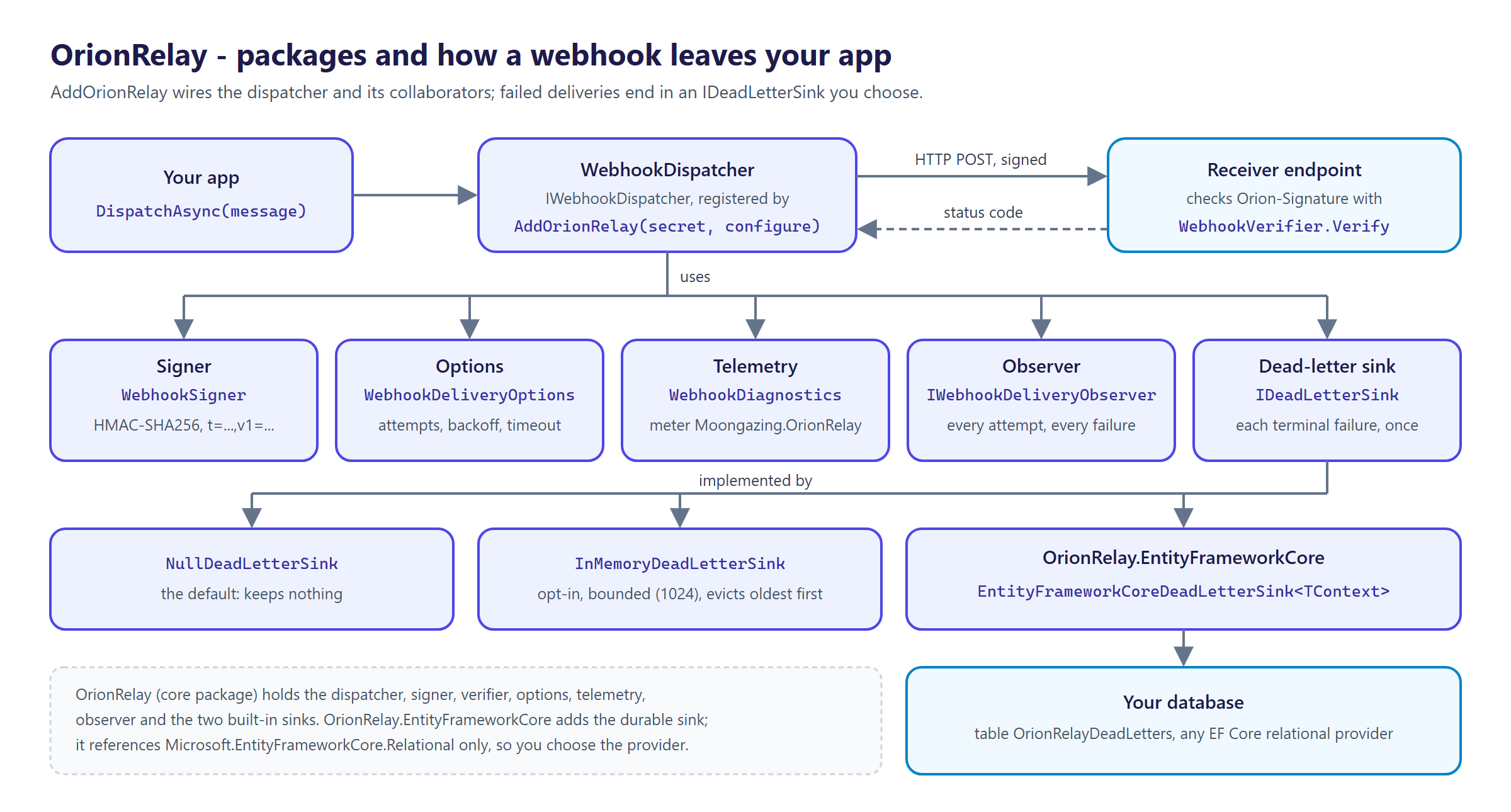
Packages
| Package | What it adds |
|---|---|
OrionRelay | The dispatcher, signer, receiver-side verifier, options, telemetry, observer hook and the two built-in dead-letter sinks. |
OrionRelay.EntityFrameworkCore | A durable IDeadLetterSink over a relational table via EF Core, so abandoned deliveries survive a restart. |
Why
Delivering a webhook reliably is more than one HttpClient.PostAsync. You need request signing
so receivers can trust the payload, retries that distinguish a transient 503 from a permanent
400, backoff with jitter so a fleet of senders does not stampede a recovering receiver, and
telemetry so you can see delivery health. OrionRelay packages those decisions so you do not
re-derive them per project.
Features
- HMAC-SHA256 request signing. Every attempt carries an
Orion-Signatureheader of the formt=<unix-seconds>,v1=<hex-hmac>, with the send timestamp bound into the MAC so a receiver can reject replays. - Transient-aware retries. Transport faults, per-attempt timeouts, and HTTP
408/429/5xxare retried; any other4xxfails fast. - Equal-jitter exponential backoff. Backoff doubles per attempt, clamps to a ceiling, and randomises half the delay so concurrent senders do not retry in lockstep.
- Per-attempt telemetry. A
System.Diagnostics.Metricsmeter exposes delivery/attempt counters and an attempts-per-delivery histogram, ready for OpenTelemetry. - Receiver-side verification.
WebhookVerifierchecks the signature and the freshness window in constant time and returns the reason a request was rejected instead of throwing. - Fault-safe delivery observer. An optional hook sees every attempt and every delivery that ends without success, for alerting or audit; faults it raises never break delivery.
- Pluggable dead-letter sink. Deliveries that exhaust their attempt budget are routed to an
IDeadLetterSinkexactly once, carrying their terminal failure context, so you can persist, alert on, or replay them. The default is a no-op; a boundedInMemoryDeadLetterSinkwith oldest-first eviction is available as an opt-in,OrionRelay.EntityFrameworkCoreadds a durable one, and faults the sink raises never break delivery. - One-call DI registration.
AddOrionRelaywires a dedicatedHttpClient, the signer, the diagnostics, and the dispatcher, validating your options eagerly. - Multi-targeted.
net8.0,net9.0, andnet10.0, with nullable enabled and warnings as errors.
Install
dotnet add package OrionRelay
dotnet add package OrionRelay.EntityFrameworkCore   # optional: durable dead-letter store
The NuGet package ids are OrionRelay and OrionRelay.EntityFrameworkCore; the root
namespaces are Moongazing.OrionRelay and Moongazing.OrionRelay.EntityFrameworkCore.
Quick start
Register OrionRelay with a shared signing secret and optional delivery tuning:
using Moongazing.OrionRelay;

services.AddOrionRelay(signingSecret: "whsec_your_shared_secret", o =>
{
    o.MaxAttempts = 5;
    o.BaseDelay = TimeSpan.FromSeconds(2);
    o.MaxDelay = TimeSpan.FromMinutes(1);
});
Inject IWebhookDispatcher and send a signed payload:
using Moongazing.OrionRelay.Delivery;

public sealed class OrderEvents(IWebhookDispatcher dispatcher)
{
    public async Task NotifyAsync(Uri subscriber, byte[] payload, CancellationToken ct)
    {
        var result = await dispatcher.DispatchAsync(new WebhookMessage
        {
            Endpoint = subscriber,
            Body = payload,
            EventId = Guid.NewGuid().ToString("N"),
            EventType = "order.created",
        }, ct);

        if (!result.Succeeded)
        {
            // Persist for later redelivery; result.Attempts / result.StatusCode tell you why.
        }
    }
}
DispatchAsync returns when delivery succeeds (a 2xx response), a non-retryable status ends it, or
the attempt budget is exhausted.
A cancelled token aborts the whole delivery, including backoff waits, and throws
OperationCanceledException rather than returning a failure result.
Usage
Sending a webhook
WebhookMessage describes a single delivery:
| Property | Type | Notes |
|---|---|---|
Endpoint | Uri | Required. The absolute endpoint to POST to. |
Body | ReadOnlyMemory<byte> | Required. Transmitted verbatim and covered by the signature. |
ContentType | string | Defaults to application/json. Sets the request Content-Type. |
EventId | string? | Optional. Sent as the Orion-Event-Id header for receiver-side deduplication. |
EventType | string? | Optional. Sent as the Orion-Event-Type header and used for the event_type telemetry tag. |
WebhookDeliveryResult reports the outcome:
| Member | Type | Notes |
|---|---|---|
Succeeded | bool | True when a 2xx response arrived within the attempt budget. |
Attempts | int | Attempts made, including the first send. |
StatusCode | int? | HTTP status of the final attempt, or null when the final attempt failed at the transport level (fault or timeout). |
FinalException | Exception? | The final attempt's transport fault or timeout, when delivery ended on one rather than an HTTP error. |
Signature verification on the receiver
When a signing secret is configured, every request carries an Orion-Signature header of the form
t=<unix-seconds>,v1=<hex-hmac>. The HMAC-SHA256 is taken over <unix-seconds>.<body>, so the
timestamp is bound into the MAC. A receiver verifies by recomputing the MAC over the exact raw body
it received and rejecting requests whose timestamp falls outside a freshness window, which stops
replays.
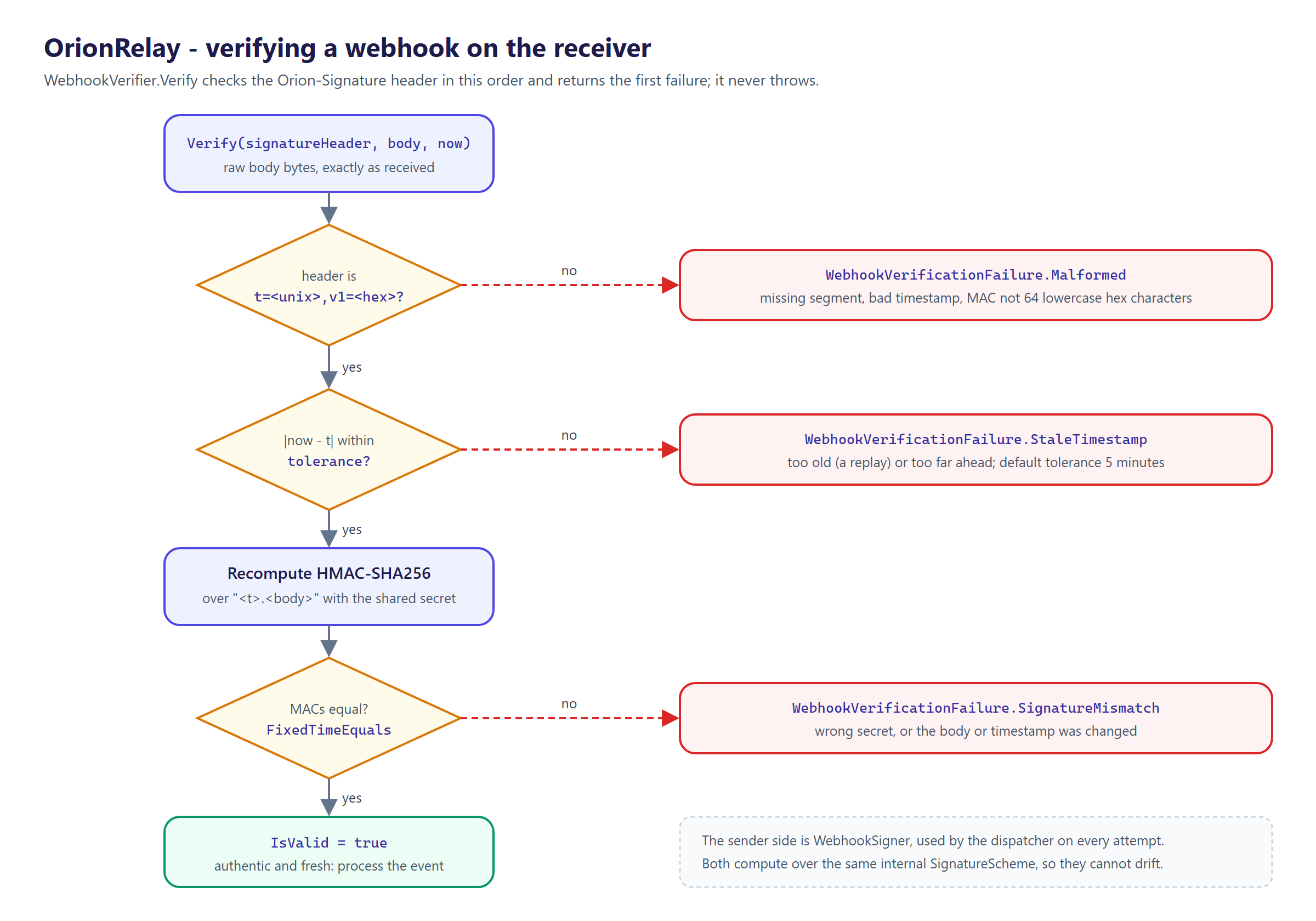
WebhookVerifier is the receiver-side counterpart to WebhookSigner. It recomputes the MAC over
the same canonical preimage the signer uses, enforces the freshness window in both directions, and
compares in constant time. Verify returns a WebhookVerificationResult rather than throwing, so a
receiver can branch on the specific reason a request was rejected.
using Moongazing.OrionRelay.Signing;

// Construct once with the shared secret and a freshness window, then reuse.
var verifier = new WebhookVerifier(secret, tolerance: TimeSpan.FromMinutes(5));

// In the request handler, verify against the raw body bytes exactly as received.
var result = verifier.Verify(signatureHeader, rawBody, now: DateTimeOffset.UtcNow);
if (!result.IsValid)
{
    return result.Failure switch
    {
        // Header could not be parsed, or the timestamp is outside the window: reject the request.
        WebhookVerificationFailure.Malformed => Results.BadRequest(),
        WebhookVerificationFailure.StaleTimestamp => Results.StatusCode(StatusCodes.Status408RequestTimeout),
        // The signature did not match: treat as unauthorized.
        _ => Results.Unauthorized(),
    };
}

// Signature authentic and fresh: process the event.
Verify against the raw bytes exactly as received, before any deserialization reshapes them. The
default freshness window is WebhookVerifier.DefaultTolerance (5 minutes) when you do not pass one.
The sender side of this contract is IWebhookSigner.Sign(ReadOnlySpan<byte> body, DateTimeOffset timestamp).
Retries and backoff
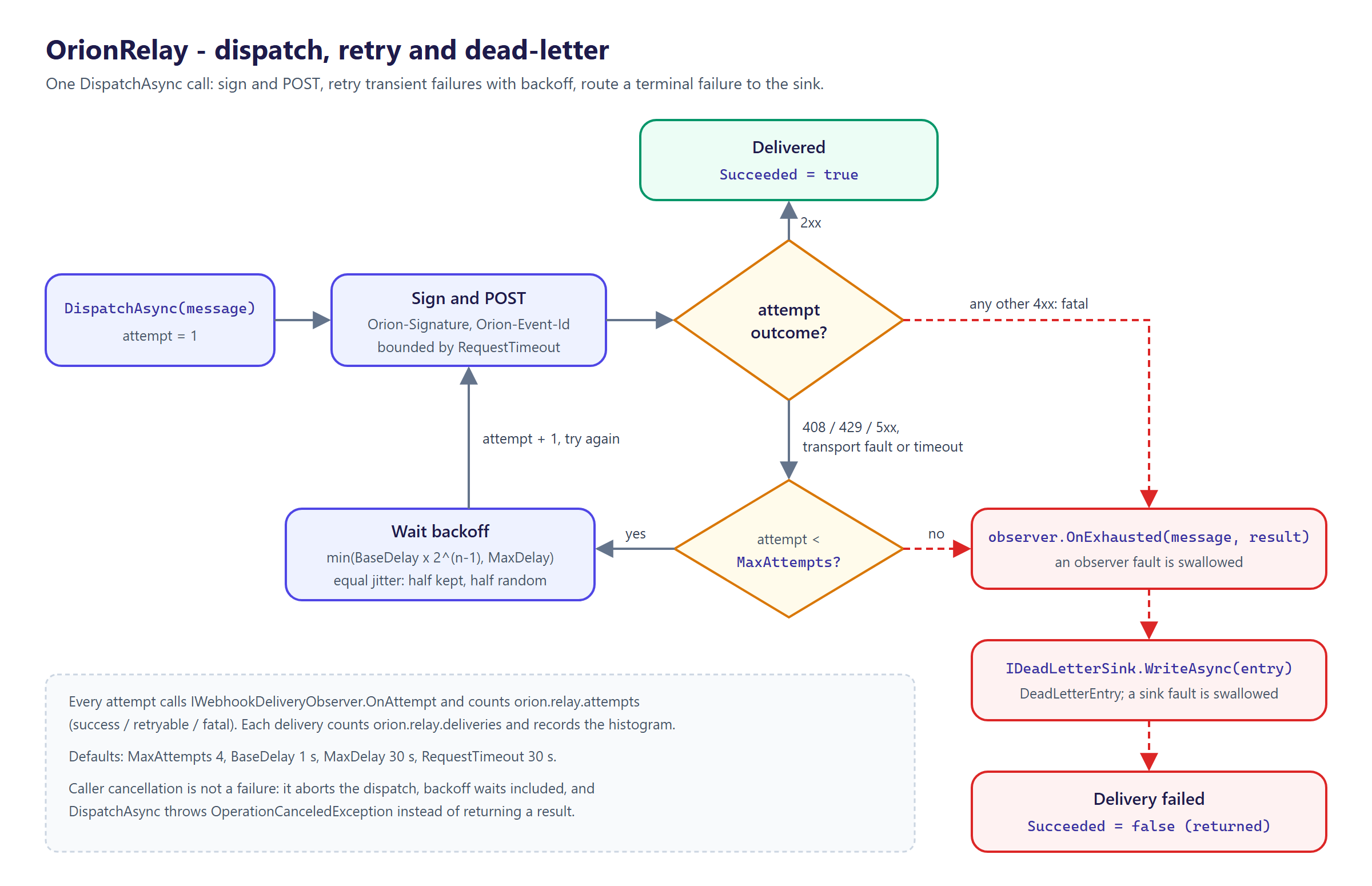
An attempt is retried when it produces a transport fault, a per-attempt timeout, or an HTTP
408, 429, or 5xx. Any other 4xx is treated as permanent and fails fast. Backoff is
exponential from BaseDelay, doubled per attempt and clamped to MaxDelay, with equal jitter
(half the computed delay kept as a floor, the other half randomised) so concurrent senders do not
retry in lockstep. The dispatcher enforces a per-attempt timeout (RequestTimeout) independently
of the HttpClient, which AddOrionRelay leaves uncapped so the two do not race.
Delivery observer hook
Implement IWebhookDeliveryObserver and register it in DI before resolving the dispatcher to see
every attempt and every delivery that ends without success (budget exhausted or a non-retryable
status), for alerting or audit:
using Microsoft.Extensions.DependencyInjection;
using Moongazing.OrionRelay.Delivery;
using Moongazing.OrionRelay.Observers;

public sealed class DeadLetterObserver(IDeadLetterStore store) : IWebhookDeliveryObserver
{
    public void OnAttempt(WebhookMessage message, int attempt, int? statusCode, Exception? exception)
    {
        // Per-attempt visibility: log, count, trace.
    }

    public void OnExhausted(WebhookMessage message, WebhookDeliveryResult result)
    {
        // The delivery failed for good (budget spent or a non-retryable status). Park it.
        store.Park(message, result);
    }
}

// Register the observer before AddOrionRelay resolves the dispatcher.
services.AddSingleton<IWebhookDeliveryObserver, DeadLetterObserver>();
services.AddOrionRelay(signingSecret: "whsec_your_shared_secret");
The observer is observability only. The dispatcher swallows any exception it raises, so an observer
outage never breaks delivery. If you register none, a no-op (NullWebhookDeliveryObserver) is used.
Dead-letter sink
When a delivery terminates without success, the dispatcher routes it to an IDeadLetterSink
exactly once, after the final attempt, so a consumer can persist, alert on, or replay it. A delivery
terminates either by exhausting its retry budget or by hitting a fatal, non-retryable response (for
example an HTTP 400), so the sink receives any terminal non-success, not only budget-exhausted ones.
The sink receives a DeadLetterEntry carrying the original message, the terminal
WebhookDeliveryResult, and the instant the delivery was abandoned:
| Member | Type | Notes |
|---|---|---|
Message | WebhookMessage | The message that could not be delivered within its attempt budget. |
Result | WebhookDeliveryResult | The terminal failure result: attempts made, last status, and final transport fault. |
DeadLetteredAt | DateTimeOffset | The instant the delivery was abandoned and routed to the sink. |
AddOrionRelay registers the no-op NullDeadLetterSink by default, which retains nothing and so
cannot grow the process working set during a prolonged receiver outage. Register your own sink
before the dispatcher resolves to capture abandoned deliveries instead. A durable store is the
right choice for production; for tests, demos, and single-process apps the library ships a bounded
InMemoryDeadLetterSink that retains the most recent entries in arrival order and evicts the
oldest once full:
using Microsoft.Extensions.DependencyInjection;
using Moongazing.OrionRelay;
using Moongazing.OrionRelay.Delivery;

// Opt in to the in-memory sink, bounded to the 256 most recent abandoned deliveries.
services.AddSingleton<IDeadLetterSink>(new InMemoryDeadLetterSink(capacity: 256));
services.AddOrionRelay(signingSecret: "whsec_your_shared_secret");
The capacity argument is optional; the parameterless constructor retains up to
InMemoryDeadLetterSink.DefaultCapacity (1024) entries. Inspect what has been captured through
Count and the oldest-first Entries snapshot:
public sealed class FailedDeliveryReport(IDeadLetterSink sink)
{
    public void Print()
    {
        if (sink is not InMemoryDeadLetterSink inMemory)
        {
            return;
        }

        foreach (var entry in inMemory.Entries)
        {
            Console.WriteLine(
                $"{entry.DeadLetteredAt:o} {entry.Message.EventType} " +
                $"failed after {entry.Result.Attempts} attempts " +
                $"(last status: {entry.Result.StatusCode?.ToString() ?? "none"})");
        }
    }
}
To persist or replay instead, implement IDeadLetterSink over your own store:
using Moongazing.OrionRelay.Delivery;

public sealed class DurableDeadLetterSink(IDeadLetterStore store) : IDeadLetterSink
{
    public async Task WriteAsync(DeadLetterEntry entry, CancellationToken cancellationToken = default)
    {
        // Persist for later inspection or redelivery. Keep this resilient: the dispatcher swallows
        // any fault raised here, so a sink outage cannot turn an already-failed delivery into an
        // exception for the caller.
        await store.SaveAsync(entry, cancellationToken);
    }
}

services.AddSingleton<IDeadLetterSink, DurableDeadLetterSink>();
services.AddOrionRelay(signingSecret: "whsec_your_shared_secret");
The sink and the delivery observer are complementary: IWebhookDeliveryObserver.OnExhausted fires
first for in-process observability, then the entry is written to the sink for durable capture.
Durable dead-letter store (EF Core)
OrionRelay.EntityFrameworkCore ships that durable sink. EntityFrameworkCoreDeadLetterSink<TContext>
stores each entry as a DeadLetterRecord row (endpoint, payload, content type, event headers,
attempts, last status, final error message, abandonment time), keyed by the message EventId so a
re-routed delivery updates its row instead of duplicating it (a delivery without an EventId gets a
surrogate key). It references Microsoft.EntityFrameworkCore.Relational only; add the provider you use.
using Microsoft.EntityFrameworkCore;
using Moongazing.OrionRelay;
using Moongazing.OrionRelay.EntityFrameworkCore;

// Replaces the no-op default sink, in either call order.
services.AddOrionRelayEntityFrameworkCoreDeadLetterSink(o => o.UseSqlServer(connectionString));
services.AddOrionRelay(signingSecret: "whsec_your_shared_secret");
The bundled OrionRelayDeadLetterDbContext maps the OrionRelayDeadLetters table; to host it in
your own context, apply DeadLetterRecordConfiguration in OnModelCreating and call
AddOrionRelayEntityFrameworkCoreDeadLetterSink<AppDbContext>(...). The sink does not create the
schema: add a migration. GetHeldAsync(limit) and CountAsync() on the concrete sink read the parked
deliveries back, newest first. The package does not claim NativeAOT or trimming support, because EF
Core's runtime does not. See the
package README for the full setup.
Configuration
WebhookDeliveryOptions is configured through the AddOrionRelay callback and validated eagerly at
registration (an invalid combination throws ArgumentOutOfRangeException there, not at first send):
| Option | Type | Default | Meaning |
|---|---|---|---|
MaxAttempts | int | 4 | Total attempts including the first send. Must be at least 1. |
BaseDelay | TimeSpan | 1s | Base backoff delay, doubled each retry. Cannot be negative. |
MaxDelay | TimeSpan | 30s | Ceiling the exponential backoff is clamped to. Cannot be less than BaseDelay. |
RequestTimeout | TimeSpan | 30s | Per-attempt HTTP timeout, enforced by the dispatcher. |
SignatureHeader | string | Orion-Signature | Header name carrying the signature value. |
Pass the signing secret as the first argument to AddOrionRelay. A null or empty secret registers
no signer and sends unsigned, which is not recommended outside trusted networks.
Telemetry
WebhookDiagnostics exposes a System.Diagnostics.Metrics meter named Moongazing.OrionRelay
(also available as the WebhookDiagnostics.MeterName constant). Subscribe to it from OpenTelemetry
or any MeterListener:
| Instrument | Kind | Tags |
|---|---|---|
orion.relay.deliveries | Counter<long> | orion.outcome (succeeded/failed), event_type |
orion.relay.attempts | Counter<long> | orion.outcome (success/retryable/fatal) |
orion.relay.delivery.attempts | Histogram<int> | event_type |
orion.relay.deliveries counts one per DispatchAsync call; orion.relay.attempts counts each
individual HTTP attempt; the histogram records how many attempts each delivery took. With
OpenTelemetry:
using Moongazing.OrionRelay.Diagnostics;

builder.Services.AddOpenTelemetry()
    .WithMetrics(metrics => metrics.AddMeter(WebhookDiagnostics.MeterName));
The diagnostics instance is registered as a singleton by AddOrionRelay. It derives from the
family's OrionInstrumentation (Orion.Abstractions), so tags set through
WebhookDiagnostics.SetStaticTags (for example tenant or region) are added to every measurement.
Testing
The dispatcher is built for deterministic testing. An internal constructor accepts seams for the
backoff delay, jitter source, and clock, so tests can run the retry loop with zero real waits, a
fixed jitter, and a fixed now. The signer is deterministic for a given secret, body, and
timestamp. The suite covers signing (envelope shape, determinism, timestamp and secret sensitivity,
empty-secret rejection), delivery (first-attempt success, retry-then-success, fail-fast on 4xx,
budget exhaustion, transport-fault retry, signing, caller cancellation, observer-fault isolation),
verification, the dead-letter sinks, and DI registration. The EF Core sink is tested against a real
file-backed SQLite database (restart, idempotent re-route, concurrent writers, inspection queries),
and CI publishes a NativeAOT smoke test of the sign/verify round trip.
dotnet test
Microbenchmarks for the CPU-bound send-path work (signing, signer construction, telemetry emission)
live under benchmarks/ and run with BenchmarkDotNet. See benchmarks.md.
Versioning
OrionRelay follows Semantic Versioning. The current release
is 0.5.0; while on the 0.x line the public surface may still change between minor versions.
Notable changes are recorded in CHANGELOG.md.
Design notes
- Multi-targets
net8.0,net9.0,net10.0. TreatWarningsAsErrors, latest analyzers, nullable enabled.- The dispatcher enforces its own per-attempt timeout, so its
HttpClientis left uncapped.
Documentation
- docs/FEATURES.md - the public surface, feature by feature.
- OrionRelay package README and OrionRelay.EntityFrameworkCore package README - the NuGet pages.
- docs/ROADMAP.md - directions under consideration (ideas, not promises).
- benchmarks.md - what the benchmark suite measures and how to run it.
- CHANGELOG.md - notable changes per release.
- SECURITY.md - how to report a vulnerability privately.
More from the Orion family
OrionRelay is one of a set of standalone .NET libraries by the same author. See OrionGuard and the other Orion packages.
Contributing
Issues and pull requests welcome. Please read CONTRIBUTING.md and the Code of Conduct before opening one.
License
This project is licensed under the MIT License.
Author
Tunahan Ali Ozturk - GitHub
Packages
| Package | Version | Downloads |
|---|---|---|
| OrionRelay | 0.5.0 | 1,371 |
| OrionRelay.EntityFrameworkCore | 0.5.0 | 295 |