
OrionLens


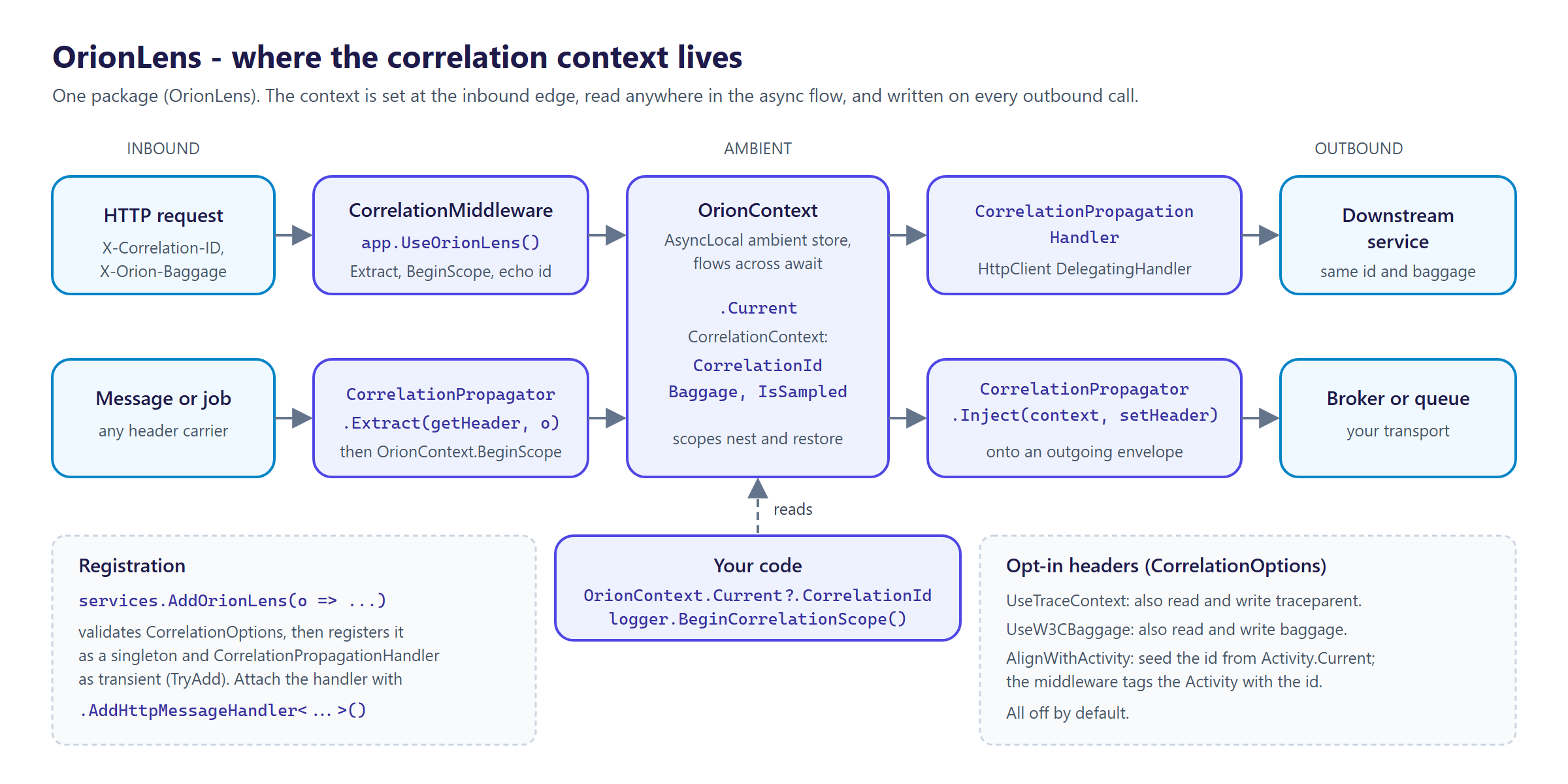
Ambient correlation context for .NET. One correlation id, plus a little baggage, is established at
the edge of a request and flows through every await and across every downstream HTTP call, so a
single logical operation is traceable end to end without threading an id through every method
signature.
Part of the Orion family. Usable entirely on its own.
Why
When a request fans out across services, you want one id stitching the logs together. Passing it
explicitly everywhere is noise; stuffing it in a [ThreadStatic] breaks the moment you cross an
await. OrionLens uses AsyncLocal so the context follows the logical flow, reads and writes it on
the HTTP boundary for you, and keeps the data model immutable so a nested scope can add baggage
without disturbing its parent.
Features
- Ambient context over
AsyncLocal.OrionContext.Currentis available anywhere in the async call chain with no parameter passing. Scopes nest and restore exactly on dispose. - Immutable context model.
CorrelationContextcarries a correlation id and a frozen baggage dictionary.WithBaggagereturns a new instance, so a child scope never mutates its parent. - HTTP-agnostic propagation.
CorrelationPropagator.Extract/Injectwork against any header getter and setter, so the same logic serves an ASP.NET request, anHttpClientrequest, or a message envelope. - ASP.NET Core middleware.
UseOrionLens()establishes the context per request, mints an id when one is missing, and echoes it back on the response. - Outbound
HttpClienthandler.CorrelationPropagationHandlerinjects the ambient context into every outbound request, so downstream services receive the same id and baggage. - W3C trace-context bridge. When
UseTraceContextis enabled, the correlation id is aligned with the W3Ctraceparentso the correlation id and the distributed trace id line up across systems. On extract, an inboundtraceparenttrace-id becomes the correlation id when no id header is present; on inject, atraceparentis emitted whose trace-id is derived from the correlation id, so it never conflicts withX-Correlation-ID. - Logging enrichment helpers.
ILogger.BeginCorrelationScope()pushes the correlation id (and selected baggage) into a logging scope, so structured logs carry it without a manualBeginScopeat every log site. Builds only on the logging abstractions and binds no logging sink. - Baggage policy. Optional caps on baggage count (
MaxBaggageCount) and encoded size (MaxBaggageBytes), and inbound-only keys (NonPropagatingBaggageKeys) that are read on extract but never emitted on inject, so headers stay small and internal values do not cross a trust boundary. - Activity integration. When
AlignWithActivityis enabled, the correlation id seeds from the currentActivity's trace-id when no id header is present, and the id (plus opted-inActivityBaggageKeys) is projected onto the currentActivityas a tag and baggage, so OrionLens andActivity-based tracing agree on the identifier. It never starts a span. - Sampling-aware correlation.
CorrelationContext.IsSampledcarries the head-based sampling decision (from theActivityrecorded flag or the inboundtraceparent).SampledOnlyBaggageKeyslets heavier diagnostic baggage ride only sampled traces; the correlation id always propagates for logging regardless. - W3C
baggageinterop. WhenUseW3CBaggageis enabled, the standardbaggageheader is read and written alongsideX-Orion-Baggage, with the baggage policy applied to both so non-propagating keys stay off either header. - No third-party dependencies. The core targets
net8.0,net9.0, andnet10.0; the ASP.NET Core surface uses only the shared framework.
Install
dotnet add package OrionLens
Quick start
Establish context on the way in, propagate it on the way out:
using Moongazing.OrionLens;
using Moongazing.OrionLens.Http;

builder.Services.AddOrionLens(o => o.CorrelationHeader = "X-Correlation-ID");

// outbound: attach the handler to any client that calls a downstream service
builder.Services.AddHttpClient("downstream")
    .AddHttpMessageHandler<CorrelationPropagationHandler>();

var app = builder.Build();
app.UseOrionLens();   // early, before logging and downstream calls

app.Run();
Read the context anywhere, with no parameter passing:
using Moongazing.OrionLens.Context;

var id = OrionContext.Current?.CorrelationId;
logger.LogInformation("Processing order {OrderId} for correlation {Correlation}", orderId, id);

var tenant = OrionContext.Current?.GetBaggage("tenant");
Usage
Baggage: add and read
Baggage is a small set of key=value string pairs carried alongside the id (a tenant id, a feature
flag). The context is immutable, so adding a pair produces a new context; open a scope over it so
the rest of the flow sees it and the previous context is restored on dispose:
using Moongazing.OrionLens.Context;

var current = OrionContext.Current!;

using (OrionContext.BeginScope(current.WithBaggage("tenant", tenantId)))
{
    // everything in here sees the tenant baggage
    var tenant = OrionContext.Current!.GetBaggage("tenant");   // tenantId
    await next();
}
// outside the using, the baggage is gone again
You can also build a context from scratch, for example at the start of a background job:
var context = CorrelationContext.Create(Guid.NewGuid().ToString("N"))
    .WithBaggage("job", "nightly-reconcile");

using (OrionContext.BeginScope(context))
{
    await RunJobAsync();
}
GetBaggage returns null for an absent key; Baggage exposes the whole set as a read-only
dictionary.
Propagation across HTTP
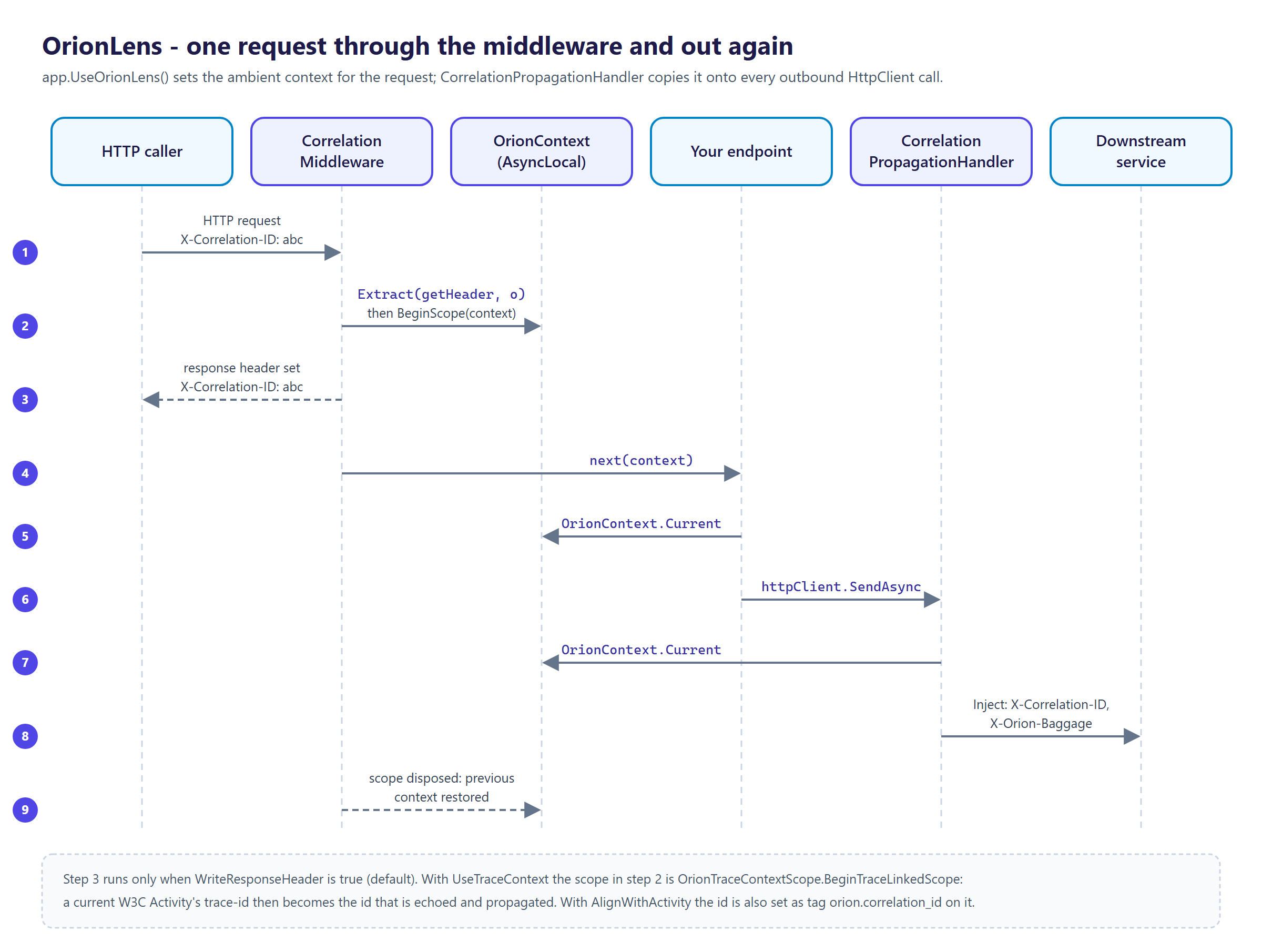
The middleware reads the inbound headers and the CorrelationPropagationHandler writes the outbound
ones. The defaults:
| Field | Header (default) | Notes |
|---|---|---|
| Correlation id | X-Correlation-ID | Read inbound, minted if absent, echoed on the response |
| Baggage | X-Orion-Baggage | key=value pairs joined by commas, each part percent-encoded |
The handler injects only when there is an ambient context; with no context, the outbound request carries no correlation headers.
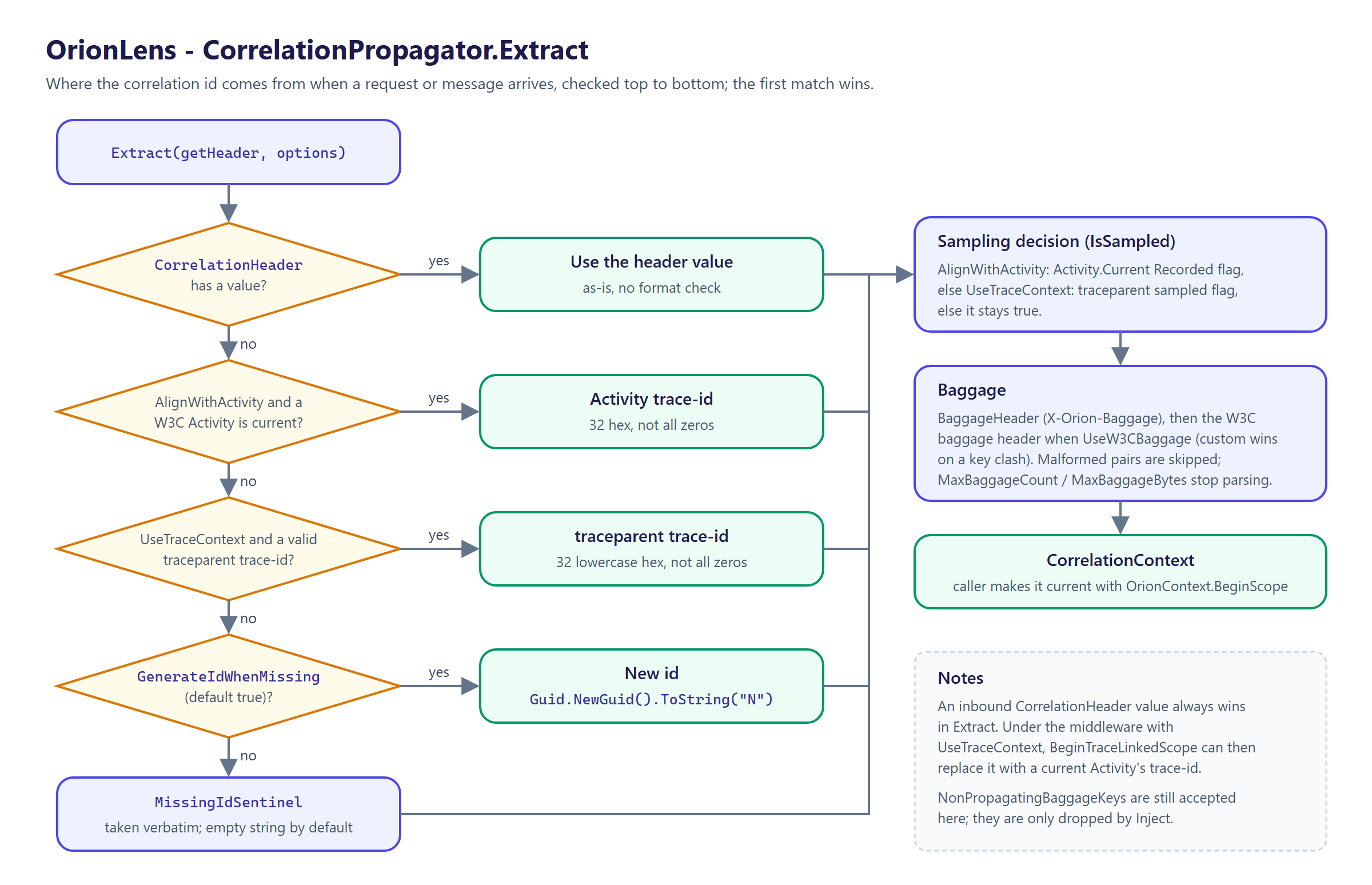
When a request arrives without an id header, Extract falls back in a fixed order:
Propagation without ASP.NET
The core (CorrelationContext, OrionContext, CorrelationPropagator) has no HTTP dependency.
Extract and Inject work against any header getter and setter, so you can carry context across a
message queue or any transport that has headers:
using Moongazing.OrionLens;
using Moongazing.OrionLens.Context;

var options = new CorrelationOptions();

// inbound: build a context from a message envelope's headers
var context = CorrelationPropagator.Extract(
    name => envelope.Headers.TryGetValue(name, out var v) ? v : null,
    options);

using (OrionContext.BeginScope(context))
{
    await HandleMessageAsync();
}

// outbound: write the current context onto a new envelope
CorrelationPropagator.Inject(
    OrionContext.Current!,
    (name, value) => outgoing.Headers[name] = value,
    options);
W3C trace-context bridge
Set UseTraceContext to align the correlation id with the W3C traceparent, so the correlation id
and the distributed trace id are the same value across systems. It is off by default, so behaviour is
unchanged until you opt in:
builder.Services.AddOrionLens(o => o.UseTraceContext = true);
With it on, Extract and Inject also read and write the traceparent header:
- On extract, when there is no
X-Correlation-IDand the inboundtraceparentcarries a valid 32-hex trace-id, that trace-id becomes the correlation id. An explicitX-Correlation-IDstill wins, so the trace-id is only adopted when no id header is present. - On inject, a
traceparentis emitted whose trace-id is derived from the correlation id (an id that is already 32 lowercase hex characters is used as-is; any other id is hashed into a stable trace-id). A liveActivityis reused only when its trace-id already matches the one the correlation id maps to, so the emittedtraceparentnever conflicts withX-Correlation-ID.
using Moongazing.OrionLens;
using Moongazing.OrionLens.Context;

var options = new CorrelationOptions { UseTraceContext = true };

// inbound carrying only a traceparent: its trace-id becomes the correlation id
var context = CorrelationPropagator.Extract(
    name => inbound.TryGetValue(name, out var v) ? v : null,
    options);

// outbound: Inject writes X-Correlation-ID and an aligned traceparent
CorrelationPropagator.Inject(
    context,
    (name, value) => outgoing[name] = value,
    options);
The trace header name is configurable through TraceParentHeader (default traceparent).
Logging enrichment
ILogger.BeginCorrelationScope() opens a logging scope carrying the ambient correlation id, so every
log written inside the using carries it without a manual BeginScope at each call site. The helper
builds only on Microsoft.Extensions.Logging.Abstractions and binds no logging sink, so it works with
any provider that honours scopes. It returns null when no context is established, so a bare using
over the result is safe:
using Moongazing.OrionLens.Logging;

using (logger.BeginCorrelationScope())
{
    logger.LogInformation("Handling order");   // scope carries CorrelationId
}
To enrich selected baggage as well, opt keys in through LoggedBaggageKeys and pass the options. Only
the named keys reach the scope, so internal or high-cardinality values stay out of logs unless you opt
them in:
var options = new CorrelationOptions();
options.LoggedBaggageKeys.Add("tenant");

using (logger.BeginCorrelationScope(options))
{
    logger.LogInformation("Handling order");   // scope carries CorrelationId and tenant
}
An overload takes an explicit CorrelationContext, for a background job or a message consumer that
holds a context directly rather than through the ambient scope.
Baggage policy
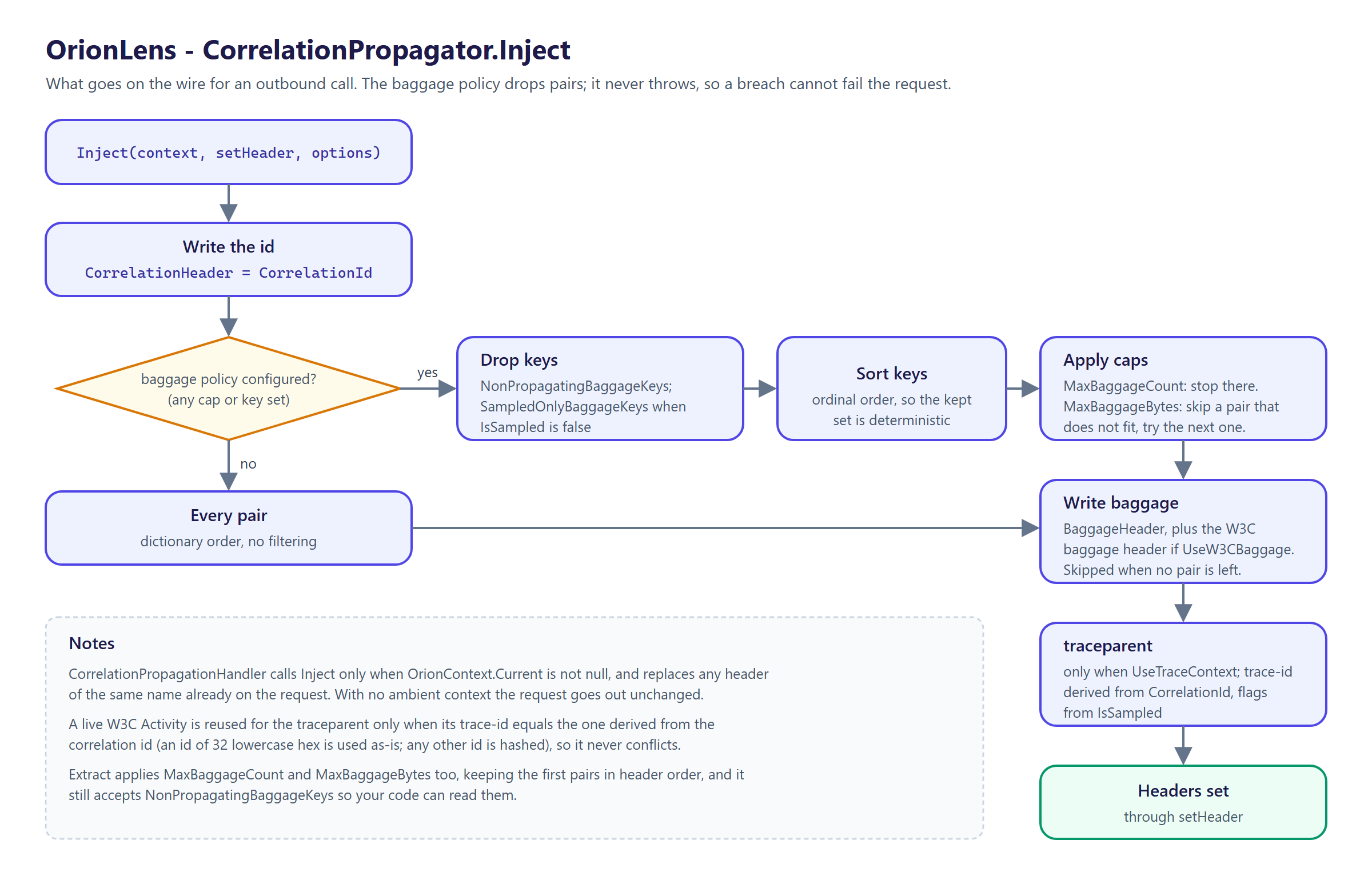
Baggage policy keeps propagated headers small and stops internal values from crossing a trust
boundary. It is enforced on both Extract and Inject, and breaches are handled by dropping pairs,
never by throwing, so a policy breach cannot fail a live request. With nothing configured (the
default), baggage propagates exactly as before.
builder.Services.AddOrionLens(o =>
{
    o.MaxBaggageCount = 8;                       // at most 8 baggage pairs cross a boundary
    o.MaxBaggageBytes = 1024;                    // at most 1024 bytes of encoded baggage header
    o.NonPropagatingBaggageKeys.Add("internal"); // read inbound, never written outbound
});
MaxBaggageCountandMaxBaggageBytescap the pair count and the encoded header size. OnInject, pairs are considered in ordinal key order, so the kept set is deterministic; a pair that would overflowMaxBaggageBytesis skipped and later, smaller pairs may still fit. OnExtract, parsing stops at the cap, so the first pairs in header order are kept.NonPropagatingBaggageKeysmarks keys inbound-only: such a key is still readable afterExtract, but it is never written onInject.SampledOnlyBaggageKeysmarks keys thatInjectwrites only when the context is sampled (CorrelationContext.IsSampled); see Activity integration and sampling.
Activity integration and sampling
Set AlignWithActivity to make OrionLens and System.Diagnostics.Activity-based tracing agree on
the identifier. It is off by default and never starts a span:
builder.Services.AddOrionLens(o =>
{
    o.AlignWithActivity = true;
    o.ActivityBaggageKeys.Add("tenant");          // copied onto Activity baggage
    o.SampledOnlyBaggageKeys.Add("debug-trace");  // propagated only on sampled traces
});
- On extract, when no id header is present and a W3C
Activityis current, its trace-id becomes the correlation id (ahead of an inboundtraceparent). - In the middleware, the correlation id is written onto
Activity.Currentas the tag named byActivityCorrelationTag(defaultorion.correlation_id), and the keys inActivityBaggageKeysare copied onto the activity's baggage when it does not already carry them. Hosts without the middleware callOrionTraceContextScope.AlignCurrentActivity(context, tag, keys)directly. CorrelationContext.IsSampledcarries the head-based sampling decision, read on extract from the currentActivity's recorded flag (withAlignWithActivity) or the inboundtraceparentflags (withUseTraceContext); otherwise it istrue. A derived outboundtraceparentreflects it.
W3C baggage interop
Set UseW3CBaggage to read and write the standard baggage header (W3CBaggageHeader) alongside
X-Orion-Baggage. On extract, the custom header wins on a key collision; on inject, the same
policy-filtered value is written to both headers. Off by default:
builder.Services.AddOrionLens(o => o.UseW3CBaggage = true);
ASP.NET Core middleware
UseOrionLens() adds CorrelationMiddleware to the pipeline. Place it early, before anything that
logs or makes downstream calls, so the ambient context is established for the whole request. The
middleware extracts the inbound id and baggage, makes them current for the rest of the pipeline, and
(when WriteResponseHeader is set) writes the id back on the response before the body starts, so the
caller sees it even on an error response.
With UseTraceContext set, the middleware opens the scope through
OrionTraceContextScope.BeginTraceLinkedScope instead of OrionContext.BeginScope. When a W3C
Activity is already current (ASP.NET Core usually starts one per request when tracing is enabled), the
correlation id is reconciled to that activity's trace-id, and that is the id echoed on the response
and propagated downstream. When none is current, an activity is started from
OrionTraceContextScope.Source (Moongazing.OrionLens) with a trace-id derived from the correlation
id, but only when something listens to that source (an ActivityListener, or OpenTelemetry with
AddSource("Moongazing.OrionLens")). With no listener, ActivitySource.StartActivity returns null,
so the scope sets only the ambient Orion context and no activity is started.
Configuration
AddOrionLens takes an optional Action<CorrelationOptions>. Options are validated eagerly at
registration, so an empty header name throws right away rather than failing at the first request.
builder.Services.AddOrionLens(o =>
{
    o.CorrelationHeader = "X-Correlation-ID";   // inbound/outbound id header
    o.BaggageHeader = "X-Orion-Baggage";        // inbound/outbound baggage header
    o.GenerateIdWhenMissing = true;             // mint a new id when inbound has none
    o.MissingIdSentinel = "";                   // id used when generation is off and none arrives
    o.WriteResponseHeader = true;               // echo the id on the response
    o.UseTraceContext = true;                   // bridge the id to the W3C traceparent
    o.TraceParentHeader = "traceparent";        // trace-context header name
    o.AlignWithActivity = true;                 // seed from / project onto Activity.Current
    o.ActivityCorrelationTag = "orion.correlation_id"; // Activity tag carrying the id
    o.ActivityBaggageKeys.Add("tenant");        // baggage keys copied onto Activity baggage
    o.UseW3CBaggage = true;                     // also read and write the W3C baggage header
    o.W3CBaggageHeader = "baggage";             // W3C baggage header name
    o.SampledOnlyBaggageKeys.Add("debug");      // baggage keys propagated only when sampled
    o.MaxBaggageCount = 8;                       // cap baggage pair count (null = no cap)
    o.MaxBaggageBytes = 1024;                    // cap encoded baggage size (null = no cap)
    o.NonPropagatingBaggageKeys.Add("internal"); // inbound-only baggage keys
    o.LoggedBaggageKeys.Add("tenant");           // baggage keys the log scope helpers include
});
| Option | Type | Default | Meaning |
|---|---|---|---|
CorrelationHeader | string | X-Correlation-ID | Header carrying the correlation id, read inbound and written outbound. |
BaggageHeader | string | X-Orion-Baggage | Header carrying baggage as percent-encoded key=value pairs joined by commas. |
GenerateIdWhenMissing | bool | true | When true, an inbound request without an id (and no trace-id to adopt) is given a freshly generated one; when false, it gets MissingIdSentinel. |
MissingIdSentinel | string | "" | The id used when GenerateIdWhenMissing is false and no id arrives. Empty by default, so the missing id is taken verbatim; set e.g. "unknown" for a non-empty placeholder. Must not be null. |
WriteResponseHeader | bool | true | When true, the middleware echoes the correlation id back on the response. |
UseTraceContext | bool | false | When true, aligns the correlation id with the W3C traceparent: adopts an inbound trace-id when no id header is present and emits a traceparent derived from the id on inject. |
TraceParentHeader | string | traceparent | Header carrying the W3C trace context, read on extract and written on inject when UseTraceContext is set. |
AlignWithActivity | bool | false | When true, an absent id is seeded from the current W3C Activity's trace-id, the sampling decision is read from it, and the middleware writes the id (and ActivityBaggageKeys) onto it. Never starts a span. |
ActivityCorrelationTag | string | orion.correlation_id | Tag key for the correlation id on the current Activity when AlignWithActivity is set. |
ActivityBaggageKeys | ISet<string> | empty | Baggage keys copied onto the current Activity's baggage when AlignWithActivity is set. |
UseW3CBaggage | bool | false | When true, the standard W3C baggage header is read and written alongside BaggageHeader, with the same policy applied to both. |
W3CBaggageHeader | string | baggage | The W3C baggage header name used when UseW3CBaggage is set. |
SampledOnlyBaggageKeys | ISet<string> | empty | Baggage keys written on inject only when the context is sampled (IsSampled). A key also in NonPropagatingBaggageKeys never propagates. |
MaxBaggageCount | int? | null | Maximum baggage pairs that cross a boundary; over the cap, pairs are dropped (in ordinal key order on inject, after the first pairs in header order on extract). null means no cap. Must be greater than zero when set. |
MaxBaggageBytes | int? | null | Maximum encoded baggage header size in bytes; over the cap, pairs are dropped (on inject a pair that does not fit is skipped and later pairs may still fit; on extract parsing stops). null means no cap. Must be greater than zero when set. |
NonPropagatingBaggageKeys | ISet<string> | empty | Baggage keys read on extract but never written on inject, so an internal value does not cross a trust boundary. |
LoggedBaggageKeys | ISet<string> | empty | Baggage keys (besides the correlation id) that the logging enrichment helpers push into a logging scope. |
AddOrionLens registers the resolved CorrelationOptions as a singleton and
CorrelationPropagationHandler as transient, so the handler is ready to attach to any named or typed
HttpClient.
Testing
The library ships with a test suite covering the immutable context, the ambient store (nesting and
async-flow restore), the propagator (extract, generate-when-missing, round-trip, baggage encoding),
the ASP.NET Core middleware, the outbound handler, DI registration, logging enrichment, the baggage
policy, Activity integration and W3C baggage interop:
dotnet test
tests/Moongazing.OrionLens.AotSmoke is a small console app that CI publishes with NativeAOT to keep
the correlation context trim- and AOT-safe.
Micro-benchmarks for the in-memory hot paths live under benchmarks/Moongazing.OrionLens.Benchmarks
and are documented in benchmarks.md. No measured numbers are committed; run them on
your own hardware.
Versioning
OrionLens follows Semantic Versioning. Notable changes are recorded in CHANGELOG.md.
Documentation
- docs/FEATURES.md - a deeper breakdown of every public type and how it behaves.
- docs/ROADMAP.md - ideas under consideration (not promises).
- benchmarks.md - what the micro-benchmarks measure and how to run them.
- SECURITY.md - how to report a vulnerability privately.
More from the Orion family
OrionLens is one of a set of standalone .NET libraries:
- OrionGuard - guard clauses and validation.
- OrionAudit - automatic EF Core change-audit trail.
Contributing
Issues and pull requests welcome. Please read CONTRIBUTING.md and the Code of Conduct before opening one.
License
This project is licensed under the MIT License.
Author
Tunahan Ali Ozturk - GitHub
Packages
| Package | Version | Downloads |
|---|---|---|
| OrionLens | 0.4.0 | 890 |